“Best of Coolidge” Readings: Vice Presidential Years, Part 3

Completing the Vice Presidential period (speeches between March 1921 and August 1923), in our “Best of Coolidge” Readings, is this shorter but incisive address given at Wheaton College, at that time an exclusively female institution, in Norton, Massachusetts, on June 19, 1923. In less than two months’ time, Coolidge would be President of the United States, and go from being relegated to the backseat of administration business to front, center, and in command of it. This speech is a fitting companion to his Evanston Address (“The Price of Freedom”), given that January, and merits a place as one of his best speeches for its clarity of expression and power of thought. His grasp of the issues is evident well before he becomes The President, as these speeches display, but there is a timeless quality to Calvin Coolidge’s speeches that simply is not found in much, if any, oratory today. His own classically liberal education certainly honed his already-present talents as a thinker and writer.

This speech not only reveals a sharp and nimble mind behind it but also holds much for the listener to appreciate now. He speaks not only about the service liberal education requires of those blessed to have it, but also about our own need to broaden perspective when it comes to whatever we do, the work (however menial) we perform, and the kind of values we expound. Coolidge says far more in thirty minutes than most do in a couple hours and this speech is no exception. He captures the beauty of living both directly and indirectly under the influence of classically liberal education, embodying far more than trivia that prepares one for Jeopardy, it is rather a comprehensive equipment of body, mind, and soul…something altogether missing from too many schoolrooms these days. Coolidge is speaking of more than “cookie-cutter” education or factory-made humanity, he extols the freedom and worth of the individual, the dignity of work, and, by preserving the primacy of the unseen and spiritual over the worldly and material, gives us a glimpse into the richness and grandeur of the true art of living afforded by classically liberal education.

The more classical education returns in our homes, throughout our neighborhoods, and in our classrooms, the brighter will the future be. I would also add, with a reappraisal of classical education, the thoughts and deeds of men like Mr. Coolidge will likewise rise in public knowledge and esteem.
On Less Is More

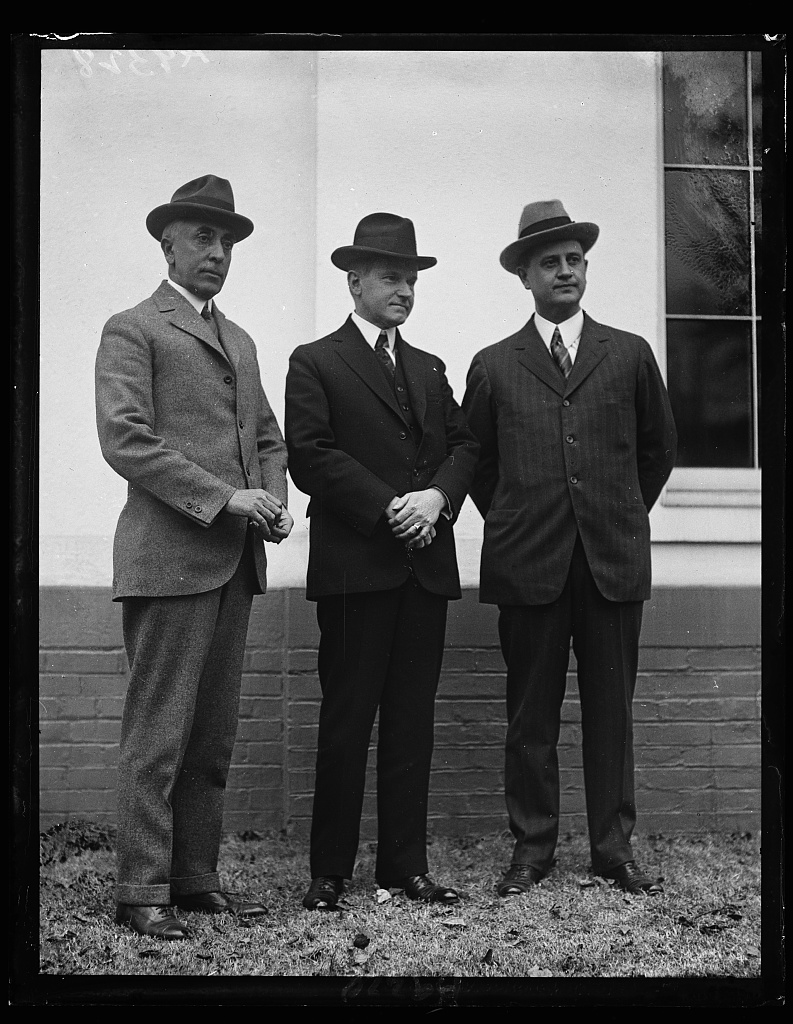
The President with outgoing secretary C. Bascom Slemp and incoming Everett Sanders, January 19, 1925, outside the Executive Offices.

The President with outgoing secretary C. Bascom Slemp and incoming Everett Sanders, January 19, 1925, outside the Executive Offices. Courtesy of the Library of Congress.

Since the Florida House ended the legislative session three days early last week, those most disappointed opine that a mere 231 bills were passed, the lowest number in seventeen years, on story claims. For those downcast by the lack of more laws, more government activity, more statewide entrenchment of measures that prudence dictates can stand – if not, outright needs – more discussion before another bill is rammed through without a full understanding of its contents or its practical implications, take a look at what Calvin Coolidge had to say about legislating.

In a letter to his father, dated September 6, 1910, shortly after the older man had been elected to the Vermont Senate, Mayor Coolidge writes, “It is much more important to kill bad bills than to pass good ones, and better to spend your time on your own committee work than by bothering with any bills of your own except in some measure that your own County or some other persons may want you to introduce for them…See that bills you recommend from your committee are so worded that they will do just what they intend and not a great deal more that is undesirable. Most bills can’t stand that test.”

Or how about this proud achievement from his days of presiding over the Massachusetts Senate, noted in Cal’s Autobiography, “I also wanted to cut down the volume of legislation. In this some progress was made. The Blue Book of Acts and Resolves for 1913 had 1,763 pages, for 1914 it has 1,423, and for 1915 only 1,230, which was a very wholesome reduction of more than thirty per cent. People were coming to see that they must depend on themselves rather than on legislation for success.” Whether due to the exertions of the Florida Speaker, the Budget Committee chairman, or the diligence of all its members, our State House should be commended for moving back toward this sound direction where less is more, where quality instead of quantity is the measure of success on behalf of our people.

As he would also declare in 1914, “Don’t hurry to legislate. Give administration a chance to catch up with legislation…”

After leaving the White House, former President Coolidge would continue to urge the same conscientious approach to the nation in his daily column on March 10, 1931, “A good measure can stand discussion. A bad bill ought to be delayed…Open debate is the only shield against the irretrievable action of a rash majority.”

The ignorant assertions by some newspapers that the system in Florida is broken – since they did not get the implementation of Obamacare – is not unlike what Coolidge faced in 1916, when, in answer to the charge that profits meant the entire economic system was corrupt, he responded, “That is as sound as it would be to abolish writing to prevent forgery. We need to keep forever in mind that guilt is personal; if there is to be punishment let it fall on the evil-doer, let us not condemn the instrument.” Those who should be the most informed, helping to inform the people of Florida, are confusing the issue, blaming a system when any blame must be laid squarely on those who rush hastily considered bills to passage time and time again at the expense of our people. It is convenient how partisanship and influence only become matters of righteous indignation when the other side fails to secure what it wants. What about all the people of our state? Someone has to pay for that expenditure. As Calvin Coolidge noted more than once, “Financial stability is the first requisite of sound government.” If the money is not there, no law will create it. It is through the labor and toil of the people that every tax levied, every appropriation passed, is paid. Out of their substance comes each expenditure.

For Coolidge, as we have noted before, the end of a Congressional session was always a source of relief, most of all, to the rest of the country. Certainly, plenty went home without legislative “goodies,” (then as now) but what service was rendered to the whole people meant far more by a cessation in government action for a time. We have had too much legislative activity, it is time to rejoice for a change when legislators pause. This is no less so for state legislative sessions. Instead of condemning the Florida House for a job well done, they should be praised for this return to an example of good governance.

“Best of Coolidge” Readings: Vice Presidential Years, Part 2

Continuing the series of three in our “Best of Coolidge” speeches from the Vice Presidential years is this exceptional address given before the Evanston Sunday Afternoon Club in Evanston, Illinois, January 21, 1923. It could hardly be anticipated that he would succeed to the Presidency before the end of the year but, listening to this speech again, it can be readily seen that Mr. Coolidge was ready for the great task. He loved his country, knew its courageous and principled role in the march of history and saw at the heart of things more readily than so many around him who were lost by political details and distracted by the peripherals. In a very real and practical way, he glimpsed America’s spirit better than we see it ourselves, especially today. Few leaders dare say what he says here yet he captured the temperament, outlook, and aspirations of a nation rapidly stepping into its own confidence and sense of modern power endowed not only by its moral ideals but by its religious foundations.