On the Veto Power

“If it were not for the rules of the House and the veto power of the President, within two years these activities [expensive legislation] would double the cost of the government…Different departments and bureaus are frequently supporting measures that would make them self-perpetuating bodies to which no appointments could be made that they did not originate. While I have always sought cooperation and advice, I have likewise resisted these efforts, sometimes by refusing to adopt recommendations and sometimes by the exercise of the veto power. One of the farm relief bills, and later a public health measure, had these clearly unconstitutional limitations on the power of appointment. In the defense of the rights and liberties of the people it is necessary for the President to resist all encroachments upon his lawful authority” — Calvin Coolidge, The Autobiography pp.230, 234.

Coolidge understood the importance of preserving the constitutional powers of the Presidency, that there were responsibilities and counterbalancing checks to be jealously guarded not to be handed over to the National Legislature. The Executive was not to weaken under his tenure, it would face two major Supreme Court challenges (the “Pocket Veto Case,” 279 U.S. 655 [1929] and Myers v. United States, 272 U.S. 52 [1926]), four legislative overrides, survive a fifth attempt by Congress to undo Coolidge’s veto, and be left unchallenged forty-one times. It is also noteworthy that most of these vetoes occurred during his second term, especially in the last two years of his administration. This is noteworthy because many Presidents expend political capital, exhaust momentum, and deplete energy so that by the close of their time, little resistance is made against the onslaught of public spending, patronage, and constant resort to the Treasury. While Coolidge did not let up from beginning to end, it could almost be said that he became more tenacious about waste and favoritism in the use of our funds. The claim some have made that Coolidge was too depressed and worn out to continue the work begun before his son’s death, do not adequately account for this important component of his unremitting activity to secure the President’s powers under the Constitution, restraining the ease with which Congress and the various bureaus and agencies use the money of others.

These informative charts give both historical perspective to the use of the President’s veto power, provided by Article I, Section 7 of the Constitution, but also take a closer examination of Coolidge’s particular use of that authority during nearly six years in office. Enjoy!

First, though, the list of his vetoes:

The Coolidge Fifty

Now, a closer look at the tradition of Presidential veto use:
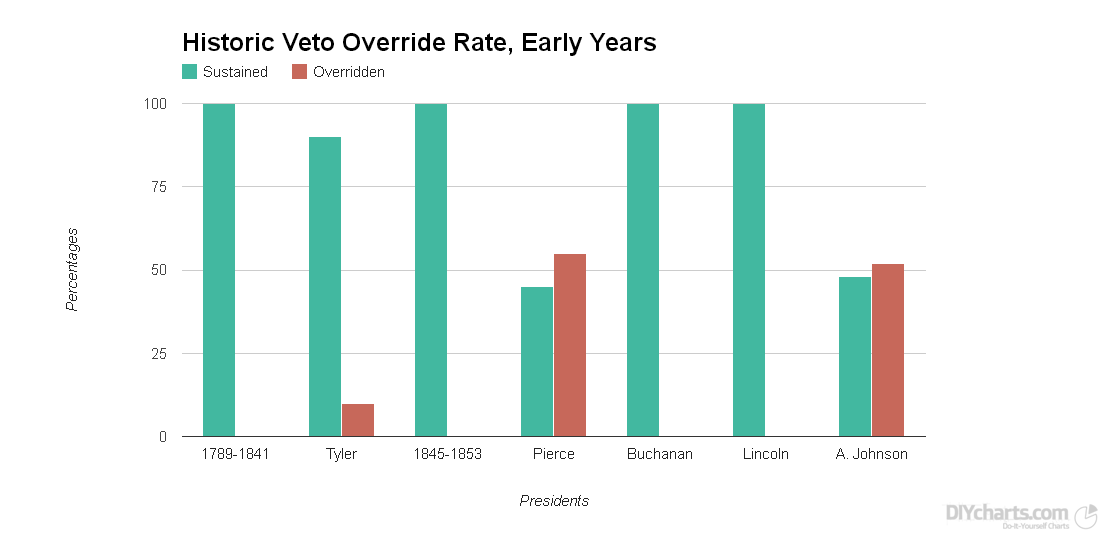
It is interesting to note that the Presidential veto was used sparingly in America's early years, a mere 31 times before the first Congressional override which occurred on March 3, 1845, countering President John Tyler's veto of special legislation for revenue cutters and steamers. Not until Pierce and again with Andrew Johnson would Presidents experience the Congressional countermand of veto power, both men undergoing the dubious and unique distinction of seeing more vetoes thrown out than sustained. While Ford came close, no other President has witnessed as consistent an opposition to the veto as Pierce and Johnson did.
It is interesting to note that the Presidential veto was used sparingly in America’s early years, a mere 31 times in fifty-six years before the first Congressional override occurred on March 3, 1845, countering President John Tyler’s veto of special legislation for revenue cutters and steamers. Not until Pierce and again with Andrew Johnson would Presidents experience the Congressional countermand of veto power, both men undergoing the dubious and unique distinction of seeing more vetoes thrown out than sustained. While Ford came close, no other President has witnessed as consistent an opposition to the veto as Pierce and Johnson did.

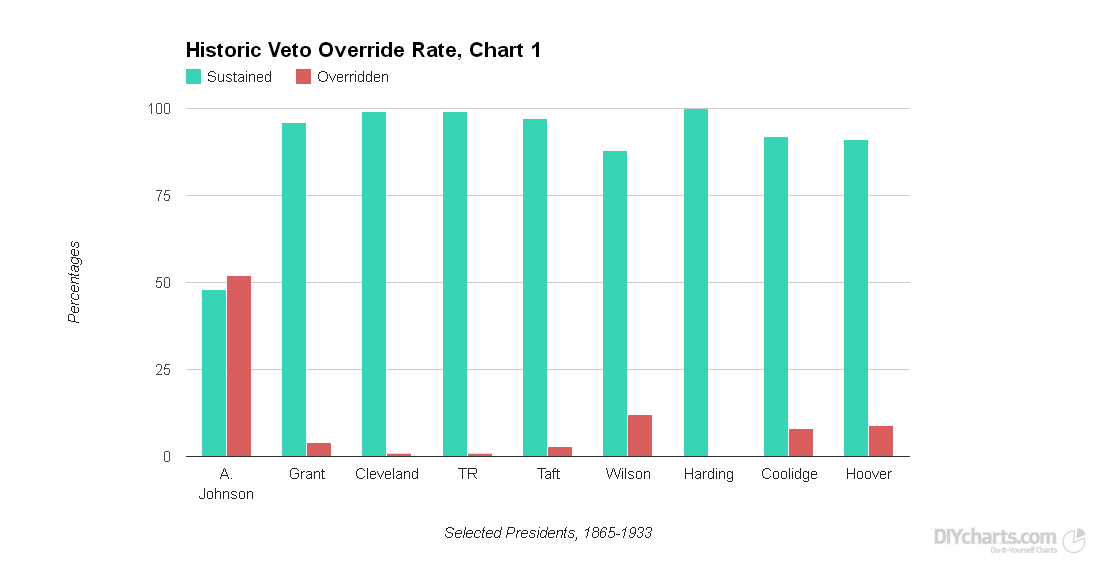
It is fascinating that Grant, so often dismissed as a weak President set the tone for a healthy use of the veto power. It would be Cleveland, whose 584 vetoes in two nonconsecutive terms, would raise the bar to the Presidential "no" on Congressional activity. Coolidge continued this strong tradition, issuing an average .75 vetoes every month in office in contrast to his last three predecessors, Harding (only six vetoes during twenty-eight months in office), Wilson (an average .5 vetoes a month for eight years, totaling forty-four), and Taft (39 in four years).

It is fascinating that Grant, so often dismissed as a weak President, set the tone for a healthy use of the veto power with 93 in eight years. It would be Cleveland, whose 584 vetoes in two nonconsecutive terms, that would raise the bar on the Presidential “no” to Congressional activity. Coolidge continued this strong tradition, issuing an average .75 vetoes every month in office in contrast to his last three predecessors, Harding (only six vetoes during twenty-eight months in office), Wilson (an average .45 vetoes a month for eight years, totaling forty-four), and Taft (39 in four years).
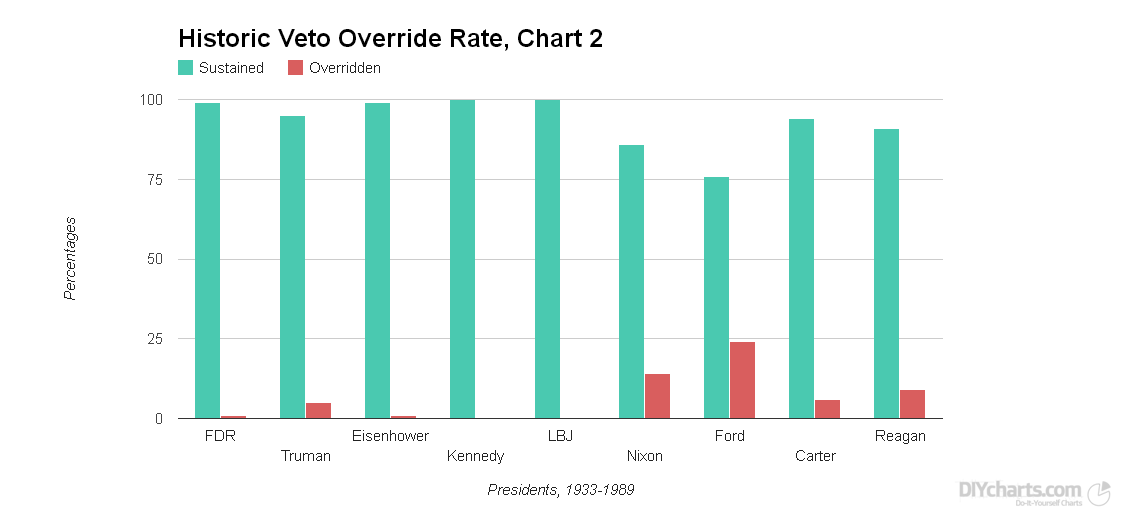
This chart, spanning a period more familiar to us, reveals a glimpse into the makeup of the Congress as well as the determination of the President. It is worthy of note that in years where different Parties control each branch, the overrides increase, whether out of legitimate constitutional checks or mere partisan opposition.

This chart, spanning a period more familiar to us, reveals the role that the makeup of the Congress has on the veto power just as it does the will of the President to wield it. It is worthy of note that in years where different Parties control each branch, the overrides increase, whether out of legitimate constitutional checks or mere partisan opposition. Since Nixon, overrides have become a regular part of every administration, whether warranted or not.
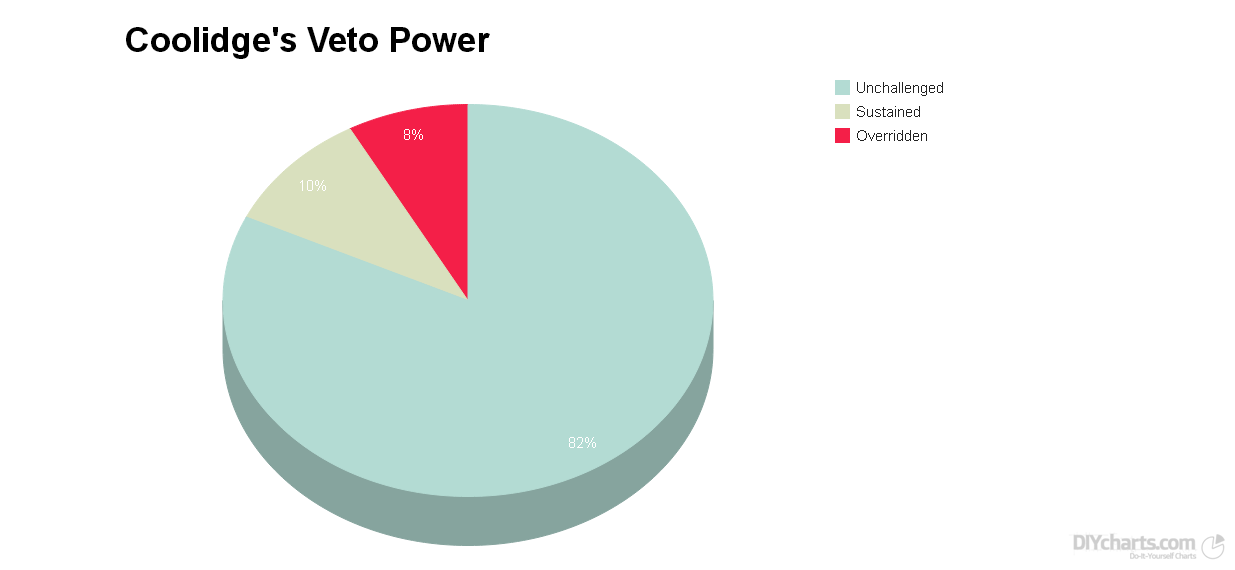
Here is a breakdown of the success rate behind Coolidge use of the veto. Only four were ever overridden by both Houses of Congress, A fifth one survived an attempted override and a sixth was upheld by the Supreme Court in the "Pocket Veto Case" (1929).

Here is a breakdown of the success rate behind Coolidge use of the veto. Only four were ever overridden by both Houses of Congress, A fifth one survived an attempted override and a sixth was upheld by the Supreme Court in the “Pocket Veto Case” (1929). An impressive 92% would stand over Congressional action. President Wilson would only ever see 88% success, with 12% of his vetoes overturned. Another 16% (eight vetoes) would come close to being undone by Congress between 1918-1921.
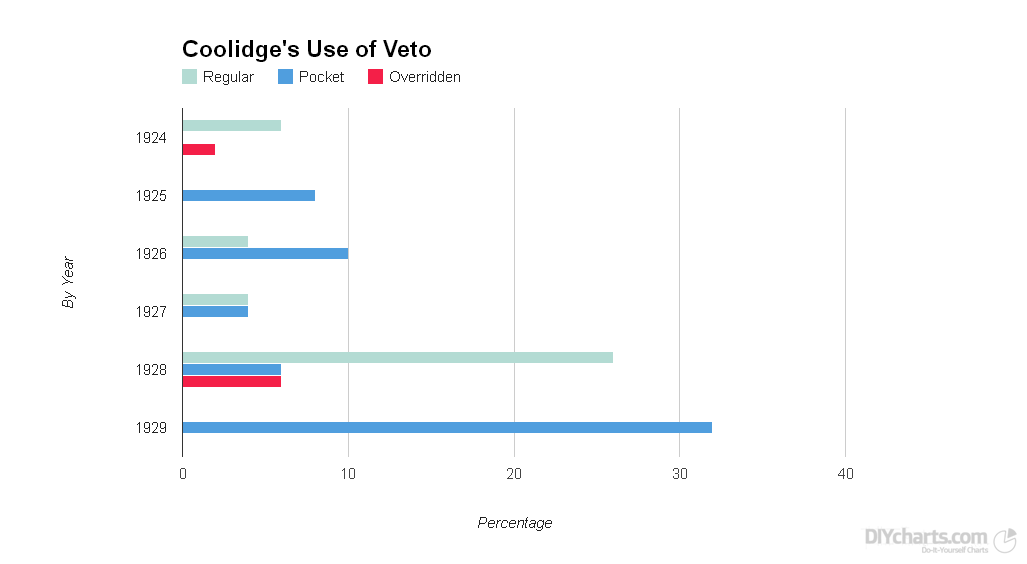
This chart not only illustrates the increase of President Coolidge's veto use as his term advanced, he had particular skill in the use of the pocket veto - holding bills of which he did not approve until Congress adjourned, thereby preventing them from becoming law by simply out-waiting the House and Senate. In this way, the Congress could take no corrective action against his veto and it would force, one or both chambers to rethink the bill and usually drop the matter altogether.

This chart not only illustrates the increase of President Coolidge’s veto use as his term advanced, he had particular skill in the use of the pocket veto – holding bills (less than ten days before the close of a Congressional session, as stipulated in the Constitution) of which he did not approve, until Congress adjourned, thereby preventing them from becoming law by simply “out-waiting” the House and Senate. In this way, the Congress could take no corrective action against his veto and it would force one or both chambers to rethink the bill and usually drop the matter altogether. May of 1928, however, was the high water mark of Congressional intransigence to Coolidge’s executive approach, when three of his vetoes were overridden in one day, May 24, 1928. Cal would have the last laugh, however, as he would brandish the pocket veto not once, three, or even ten but sixteen times while Congress, already adjourned and unable to respond, learned helplessly of it in the news. Those would form some of his last official acts in office before departing for home in Northampton on March 4, 1929.

“No…I won’t take it as a gift”

gouverneurmorris's avatarThe Importance of the Obvious

It was during Coolidge’s first term as president of the Massachusetts Senate that he clashed with Governor David Walsh, a Democrat, over a particular bill awaiting the governor’s signature. Heading over to the governor’s office, Coolidge discovered that the bill had not yet been signed. The governor’s secretary then instructed, “Come around tomorrow, senator, and I will give you the pen which he uses in its veto.” Just as quickly, Senator Coolidge shot back, “No, Mr. Secretary, I won’t take it as a gift, but I will swap it for the pen which I use to sign the bill passed over his veto.” With that, Coolidge turned and walked out. Governor Walsh knew that, with Coolidge, an override was no empty boast. The bill was signed.

Civility, for Coolidge, did not preclude his firm resolve to confront the “other side,” forcing Democrats to explain their positions to voters. When Coolidge…

View original post 270 more words

Thoughts on Tax Day

As the last of us complete our tax forms and mail off still more of our earnings, the portion of which we spent working for government, Calvin Coolidge is featured over at International Business Times today with one of his statements on tax policy. Of course, he said much more on this same occasion, declaring:

“Not only those who are now making their tax returns, but those who meet the enhanced cost of existence in their monthly bills, know by hard experience what this great burden is and what it does. No matter what others may want, these people want a drastic economy. They are opposed to waste. They know that extravagance lengthens the hours and diminishes the rewards of their labor. I favor the policy of economy, not because I wish to save money, but because I wish to save people. The men and women of this country who toil are the ones who bear the cost of the Government. Every dollar that we carelessly waste means that their life will be so much the more meager. Every dollar that we prudently save means that their life will be so much the more abundant. Economy is idealism in its most practical form.

“If extravagance were not reflected in taxation, and through taxation both directly and indirectly injuriously affecting the people, it would not be of so much consequence. The wisest and soundest method of solving our tax problem is through economy. Fortunately, of all the great nations this country is best in a position to adopt that simple remedy. We do not any longer need wartime revenues. The collection of any taxes which are not absolutely required, which do not beyond reasonable doubt contribute to the public welfare, is only a species of legalized larceny. Under this republic the rewards of industry belong to those who earn them. The only constitutional tax is the tax which ministers to public necessity. The property of the country belongs to the people of the country. Their title is absolute. They do not support any privileged class; they do not need to maintain great military forces; they ought not to be burdened with a great array of public employees. They are not required to make any contribution to Government expenditures except that which they voluntarily assess upon themselves through the action of their own representatives. Whenever taxes become burdensome a remedy can be applied by the people; but if they do not act for themselves, no one can be very successful in acting for them.

“The time is arriving when we can have further tax reduction, when, unless we wish to hamper the people in their right to earn a living, we must have tax reform. The method of raising revenue ought not to impede the transaction of business; it ought to encourage it. I am opposed to extremely high rates, because they produce little or no revenue, because they are bad for the country, and, finally, because they are wrong. We can not finance the country, we can not improve social conditions, through any system of injustice, even if we attempt to inflict it upon the rich. Those who suffer the most harm will be the poor. This country believes in prosperity. It is absurd to suppose that it is envious of those who are already prosperous. The wise and correct course to follow in taxation and all other economic legislation is not to destroy those who have already secured success but to create conditions under which every one will have a better chance to be successful. The verdict of the country has been given on this question. That verdict stands. We shall do well to heed it.

These questions involve moral issues. We need not concern ourselves much about the rights of property if we will faithfully observe the rights of persons. Under our institutions their rights are supreme. It is not property but the right to hold property, both great and small, which our Constitution guarantees. All owners of property are charged with a service. These rights and duties have been revealed, through the conscience of society, to have a divine sanction. The very stability of our society rests upon production and conservation. For individuals or for governments to waste and squander their resources is to deny these rights and disregard these obligations. The result of economic dissipation to a nation is always moral decay” — March 4, 1925, emphasis added.

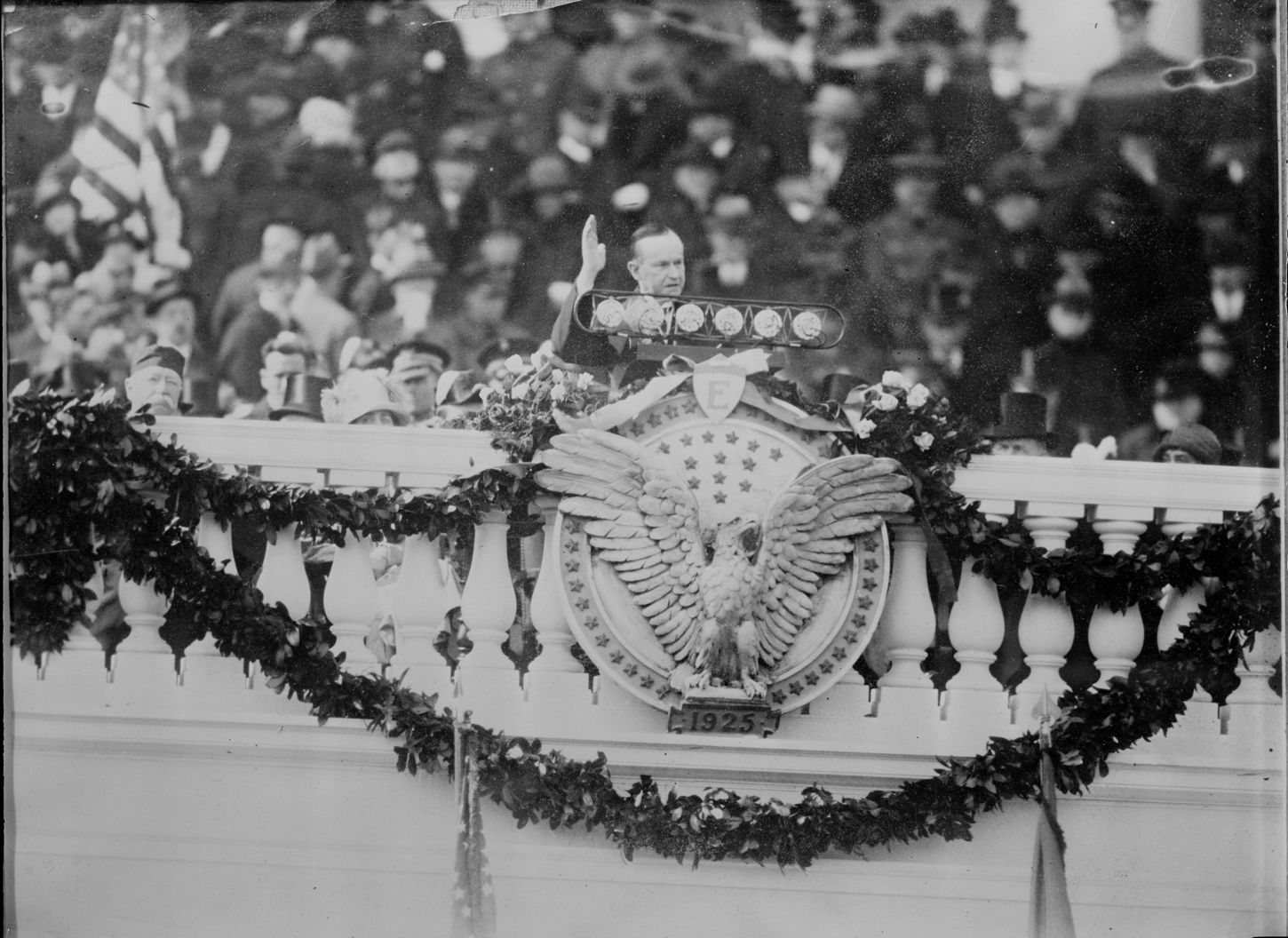
CC inauguration speech 1925