Kicking off the next three “Best of Coolidge” Readings from the Vice Presidential years, is this insightful speech entitled “The Limitations of the Law” delivered before the American Bar Association’s annual meeting held in San Francisco, August 10, 1922. While it could be said that the Supreme Court has made a few more errors of judgment than existed in Cal’s day, nevertheless, much of what he has to say here speaks just as loudly now as it did then.
Month: April 2015
Finding the Coolidge Rug’s Smaller Sister
“This, their expression of gratitude for what we have been able to do in this country for their aid, is accepted by me as a token of their goodwill to the people of the United States, who have assisted in the work of the Near East Relief. Will you be good enough to extend to these orphans my thanks and the thanks of the vast number of our citizens whose generosity this labor of love is intended to acknowledge? The rug has a place of honor in the White House, where it will be a daily symbol of good-will on earth…” To Dr. John H. Finley, Vice President of the Near East Relief Executive Board from President Calvin Coolidge, December 4, 1925.
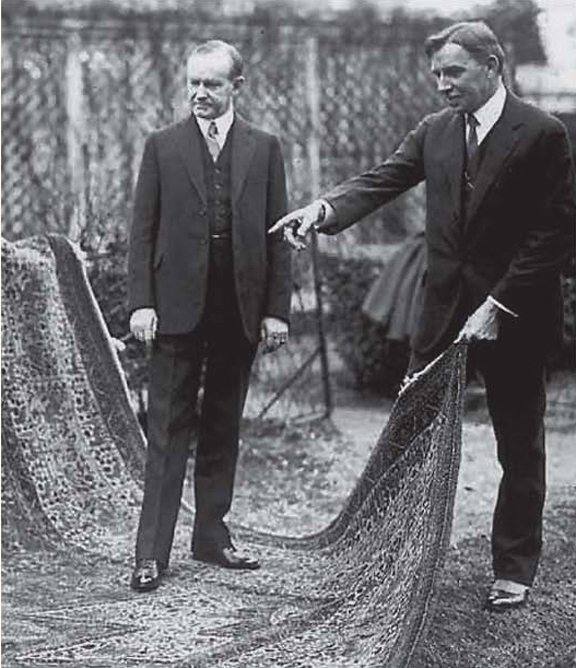
President Coolidge and Dr. Finley admiring the beautiful rug hand-made by the orphans rescued by the Kunzlers, White House lawn, 1925.
With the rediscovery and renewed appreciation for America’s crucial participation in the efforts of Near East Relief that saved dozens of Armenian orphans from the genocide of their parents one hundred years ago, the “Coolidge Rug” was finally displayed in the White House last year. It would come as an equally inspiring discovery that the smaller Kunzler Rug (named for “Papa” and “Mama” Kunzler, who selflessly rescued and cared for some 8,000 young orphans left destitute) would then turn up after seventy years in the San Diego home of 97-year old Elibet Kunzler, daughter of the couple who did so much for so many.
It is a reminder of the kindness and gratitude shown out of something horrible and tragic. It is also a reminder that President Coolidge, and his country, were there to humbly serve, gladly welcome, and abundantly give to those who had lost so much. It is hardly accidental that America is home to the largest population of Armenians living abroad. As grandson of one of the survivors, Shant Mardirossian, observed, “I couldn’t be more proud of this history, that Americans who knew nothing about Armenians 8,000 miles away gave something to help them…In fact, one could even argue a whole generation of Armenians wouldn’t be here today had it not been for their support.” God bless America and the families of the Armenian orphans!
The Next Reag… ur, Coolidge?
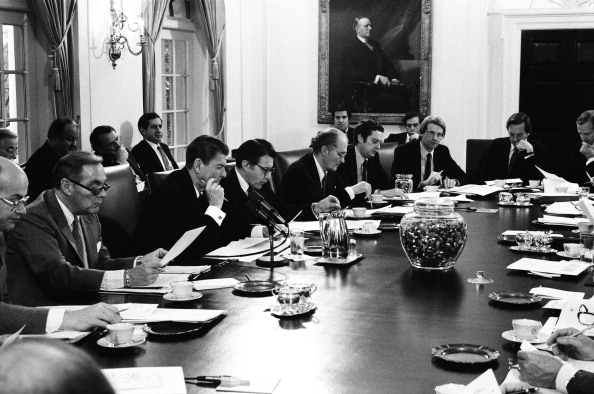
Coolidge overlooking the Reagan Cabinet Room, 1981.
It is demonstrative that real leadership and strong principles are at work when an abundant supply of “me too” candidates line up to claim the mantle and embrace the moniker of the man, whatever the era under whom we are living. Ronald Reagan, whose influence furnished so pivotal a shift in policy and, to a lesser degree, culture, was such a man. As the most determined turn away from decades of Big Government, which had been steadily growing since the 1930s, Reagan furnished the moral courage, personal confidence, and political vision (both domestically and internationally) glaringly absent from public life and yet enthusiastically yearned for by millions of folks across the country and around the world, especially after the fatalistic malaise emerging out of the 1960s and 70s under modern liberal ideologues on both sides.
However, the “Revolution,” crowned as it was with the success of Reagan’s inauguration in January 1981, would encounter an equally determined counter-reaction by those who never really warmed (combined with those always hostile toward it) to a departure from the expansive government approach of FDR and LBJ. Some adopted — as victory always attracts fans — Reagan’s party label and even some of his rhetoric but never his vision or political philosophy. As such, history repeated a not too dissimilar outcome from the election of 1928, where the nominee campaigned on the record of his predecessor and then proceeded to marginalize and repudiate it once in office. As Reagan left the White House in 1989, it was thought the country understood what his eight years represented and why they were so successful. It turns out that even after the incredible turnaround that separated 1989 from where things were in 1981 was not enough to convince even an entire generation that what they had just experienced works. No situation is permanent, and population turned over drastically no less then than it does now. However, as leadership continued the course begun pre-Reagan, a seemingly endless train of candidates have been adopting his legacy as their own.
The last presidential campaign was no less characterized by this effort to present impeccable credentials as Reagan’s legitimate heir and rightful successor. Such is human nature but in so doing, an opportunity to teach, inform and educate, regarding the principles he espoused — and why they succeed — is treated as secondary, if acknowledged at all. Reagan’s first teachable moment came out of the Goldwater campaign of 1964, with the former’s “A Time for Choosing” speech. Coolidge’s first national moment, an occasion that came unsought, launched with his principled response to the Boston Police Strike of 1919 and its aftermath. In what is sure to be an interesting campaign of 2016, the door remains open to finally explain the principles of Coolidge and Reagan, not merely mimic or pay lip service to the men. Garland Tucker III poses a fascinating question for us. Should we be modeling after Reagan alone or are we missing the one who worked, taught, and led sixty years before him? Looking at Reagan’s successes and failures, are we settling for less? Are we not depriving ourselves of a more consistent, productive and, dare we say, more substantial example in the ideas and character of Calvin Coolidge?
Laying aside, for now: 1) the oft-made mistake that Reagan authored Gaylord Parkinson’s “11th Commandment” in 1965; 2) the insinuation that challenging other Republicans over policy and philosophical differences, especially in primaries, is equivalent to violating that Commandment, inherently showing a lack of civility (and thereby no credibility or kindness — which, if such insinuation holds would condemn both Reagan and Cal); and 3) the premise that either man is replicable in a political sense…should we really be looking for the next Ronald Reagan or should we be aiming higher, for the next Calvin Coolidge?
What do you think?
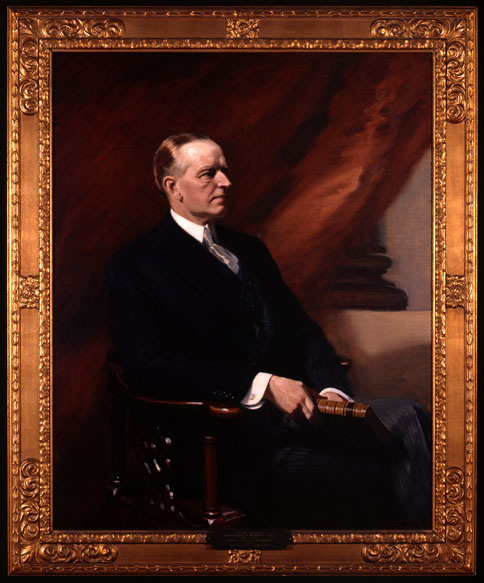
Calvin Coolidge, portrait completed posthumously by Frank O. Salisbury, 1934, for the American Antiquarian Society, Worcester, Massachusetts.
 The Importance of the Obvious