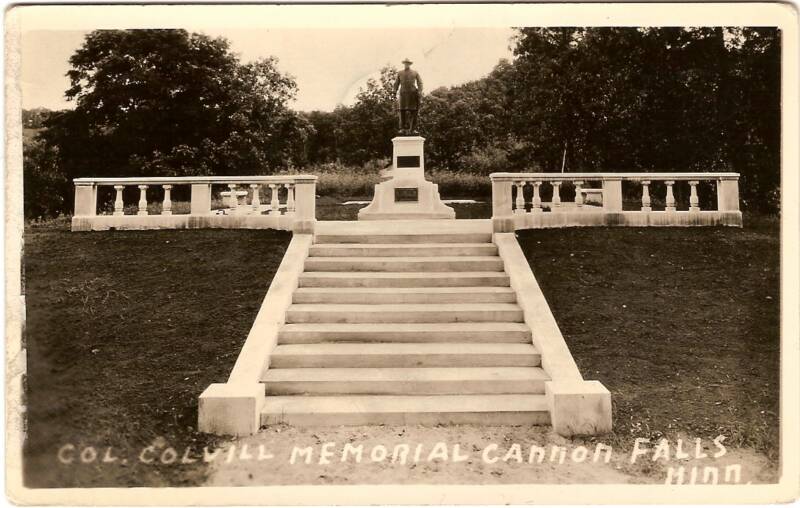
 Few today are likely to hear the name of William Colvill with anything more than a passing acknowledgement. Other than to historical enthusiasts, what Colonel Colvill did and why it is important are even more obscure to most people today. Yet, a memorial in his honor still stands an hour south of Minneapolis in the town of Cannon Falls, Minnesota. Here President Coolidge came down from Wisconsin, where he and Mrs. Coolidge were staying that summer, to dedicate the improved monument to the late Colonel on July 29, 1928, almost eighty-six years ago.
In his dedication address, President Coolidge offered more than the typical niceties and platitudes politicians evoke on such occasions. Coolidge actually reflected on the meaning of heroism and after explaining how Colvill earned that distinction, he ventured into the virtual minefield of political-geographical relations to conclude that what Colvill and his fellow soldiers of the First Minnesota did resulted in a better America, both North and South.

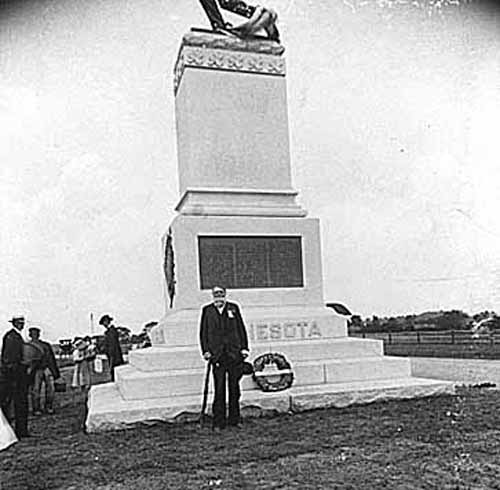
Mr. Colvill at the Monument to the heroic Americans of the First Minnesota at Gettysburg, 1897. Courtesy of the Minnesota Historical Society.
“Heroic deeds have about them an element of immortality. We stand in reverence before those who perform them and cherish their memory down through the ages because we recognize in them the manifestation of a spiritual life, the evidence of things not seen, a presence which was without beginning and is without end, a power that lifts men above the things of this earth into the realm of the divine. Except as we cherish a belief in these realities, we should have no requirement for heroic deeds and no reverence for those who do them.” “Because of their very nature,” Coolidge declared, “because a knowledge of them inspires us to higher things, it is altogether fitting that we should assemble on this Lord’s Day to reconsecrate ourselves by dedicating a memorial to one of the heroes of…Gettysburg.” Without a constant response to “that high conception of eternal duty” there can be no heroes. A reverence for the memory of those who sacrificed in its call reaffirms our belief in “right and truth and justice,” even when it requires the giving of “life itself” to support and sustain it.
A nation’s heroes, what today might be called “role models” declare in a way no other expression can whether it believes that truth exists, right is worth defending and justice can be realized. “Heroism,” after all, as Coolidge reminds us, “is not only in the man but in the occasion. While there is a certain glamor which attaches itself to the peril which the highwayman and the bandit incur in their criminal activities, it is not genuinely heroic. It will not survive analysis. It leads nowhere. Having no moral quality, it provides no inspiration. It is only a counterfeit of the reality. If it is remembered at all, it is not as a blessing but as a curse.” The un-fulfilling fascination with moral deviancy from Jesse James and Al Capone all the way to Tupac Shakur and Ice-T affirms the soundness of Coolidge’s observations, especially when it comes to our heroes.

Colonel Colvill, 1863
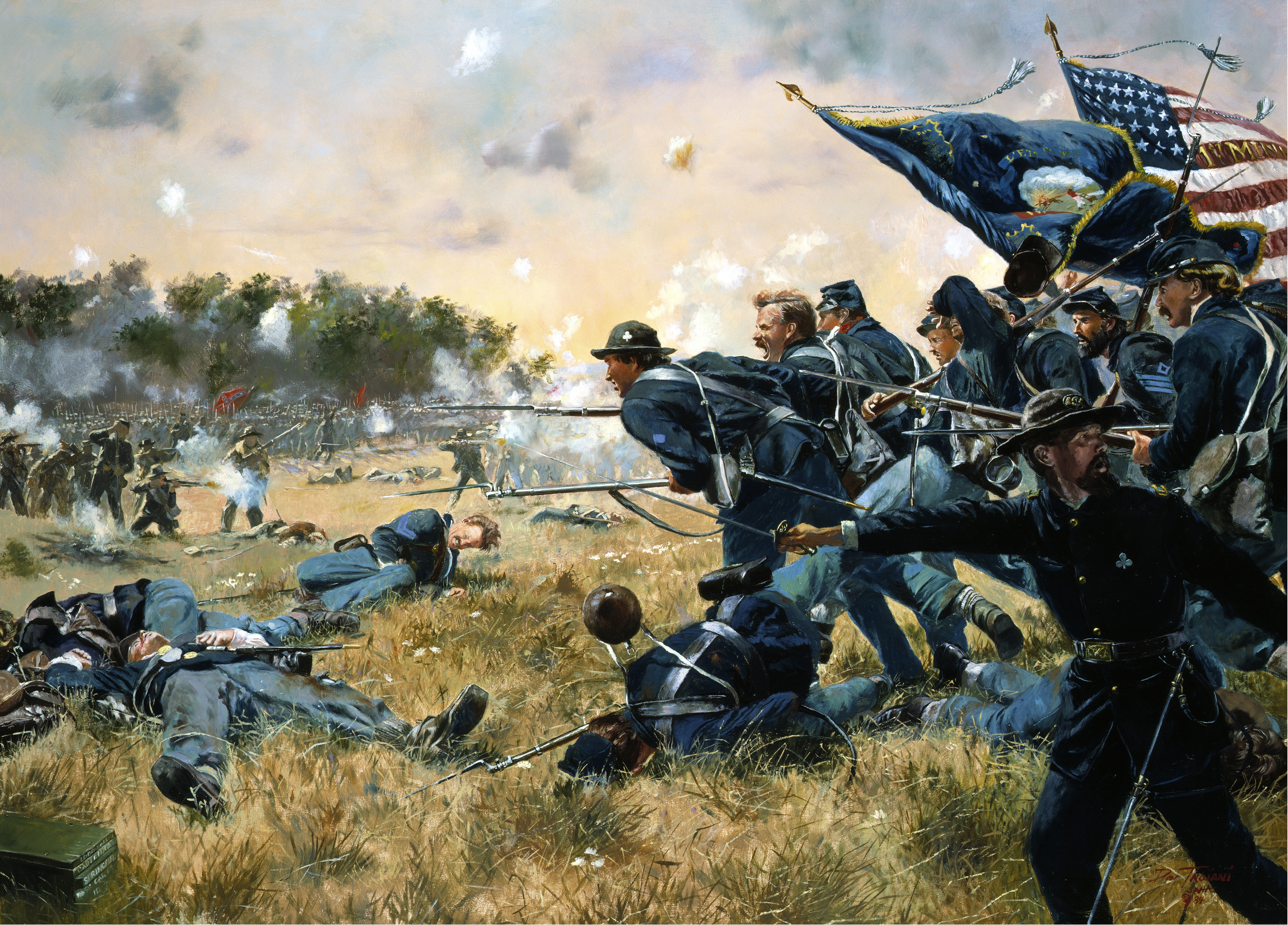
It was Colonel Colvill and the First Minnesota who turned the tide at Gettysburg on the second day of that three-day ordeal in July 1863. Just as the “overwhelming forces of the Confederates under Longstreet and Hill” were about to flank the vulnerable left side of the Union Army and proceed to roll up the entire force arrayed against them, the already depleted regiment of General Hancock, led by the eight weary companies of the First Minnesota under Colonel Colvill, rushed in to check the Confederate advance. When it was done, only 47 of the 262 men under Colvill still stood. “In all the history of warfare this charge has few, if any, equals and no superiors. It was an exhibition of the most exalted heroism against an apparently insuperable antagonist.” The actions of these Americans at so crucial a time meant something greater than preventing defeat at Gettysburg, when all was done, it saved the country, North as well as South.
“We may well stop to consider on this Sabbath Day what Power it was that stationed these men at this strategic point on this occasion, which held so much of the hope of humanity.” It was “the same Power which guided the path of the Mayflower, which gave our country Franklin and Washington, which brought this northwestern territory into the Union…and peopled it with freedom-loving immigration, which raised up Lincoln and Grant, which went to the rescue of liberty in Cuba and on the fields of France. Was it not the same Power which set these men as its sentinels on that July day to guard the progress of humanity? We we behold it all we can but conclude in the words of Holy Writ that, ‘The judgments of the Lord are true and righteous altogether.’ ”
But, someone may ask, how could this be after all that had happened to the South? Coolidge answers, “The time has come when our whole country can take a more dispassionate view of the long train of events that led up to Appomattox and the new constitutional guarantees of freedom to every inhabitant under our flag. Our national life was begun without any adequate and final declaration of the principle of freedom or demarcation of the line separating the authority of the States and the authority of the Federal Union. Some of the ablest minds of the country honestly differed in their interpretation of our institutions.” This was hardly the fault of that founding generation, it was left to later Americans to work out the never-ending task of self-government expressed in “a more perfect union,” a work that no single generation or region can complete on its own. Each generation has some great task to fulfill its part in the continuous renewal of liberty.
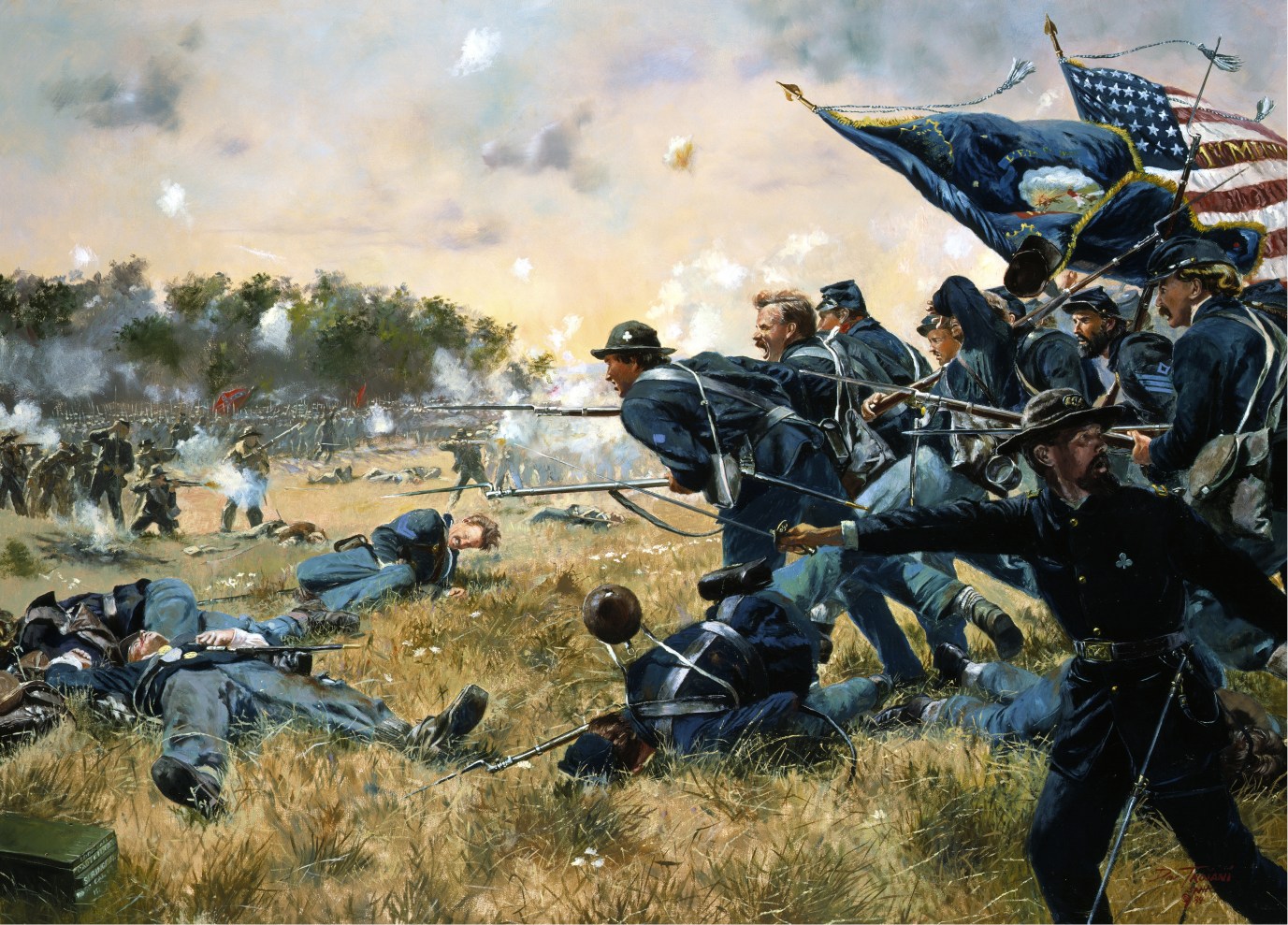
“First Minnesota at Gettysburg” by Don Troiani. 262 Minnesotans charged 1,600 Alabamans to halt the Confederate effort to flank the Union Army, July 2, 1863. Courtesy of the Minnesota National Guard.
As opinions became increasingly intensified, the “irrepressible conflict” came. Standing removed from the heat of those events, Coolidge reminds his listeners down to this day that the South is “in many ways entitled to sympathy” not “blame.” The charge of guilt for slavery and its attendant destructiveness was not to be laid at the feet of that region in particular nor to America in general. It was a “net of circumstances” from which “it was totally unable to extricate itself” alone, despite its very best thinkers deploring conditions as they were. It was a “national tragedy” that involved all people, black and white, rich and poor, North and South. The entire country could only free itself “by an appalling national sacrifice.” No one section of the nation could do so by itself, it would take everyone together accomplishing something that no people had ever done before: the defeat of a deeply-rooted institution of human nature that had prevailed in all of mankind’s history by the ideal of moral equality before our Creator. No other nation had ever fought such a conflict for such eternal truth let alone done so successfully.
At the end of the conflict, Coolidge acknowledges, the North was “depleted” while the South was “entirely prostrated.” Though the North had an earlier start and easier task, “it was necessary” for the South “to go through the long and painful process of erecting an entirely new structure. The old methods of existence and of business had to be discarded and new systems established. This would have been most difficult under any circumstances. Coming at the end of four years of conflict, it was well-nigh impossible. But the task was performed slowly and imperfectly at first, but in recent years with a rapidity that seemed scarcely possible.” It is to the rise of this “new South,” in Coolidge’s own time, that the President turned with highest praise. The region that could have remained mired in victimhood, loss and defeat, was exemplifying for all the nation to see the exceptional resilience of American ideals. Agriculture had come back stronger than before but to this had been added the development of coal, iron, water power and manufacturing. It was especially to manufacturing that the South was rebuilding on foundations for which all ultimately had fought and sacrificed on both sides.
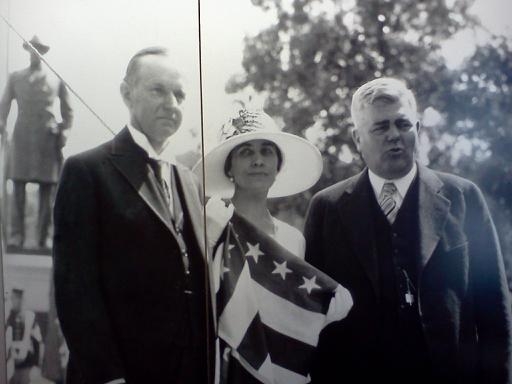
The Coolidges with Minnesota Governor Theodore Christianson in front of Colonel Colvill’s memorial, July 29, 1928
Coolidge was not speaking in empty generalities, he reiterated firm facts everyone could observe: the South was rising anew. Forty per cent of goods imported overseas came from Southern ports. Manufactured products had nearly tripled in value in less than thirty years, totaling $9.5 million. Capital invested in the manufacture of cotton had risen from $130 million to $1 billion since 1900. Bank deposits had multiplied tenfold. Public improvements likewise illustrated exponential growth in just thirty, short years. Taking stock of these incredible achievements throughout the South, President Coolidge summarized, “It is perfectly apparent that in progress and prosperity the South is going forward in a way which it could never have done under the old system.”
These developments were neither surprising nor cause for lament to Coolidge, they were the results of freedom preserved by genuine heroes, both North and South. The great historical irony is that if Colvill had not checked the Confederates at Gettysburg, the immense blessings of a “new South” would have never come to so many Americans down to our current day. The South, with all its modern possibilities, would have never been built. After all, Coolidge notes, “It has been demonstrated that what never could have been created under a condition of servitude is the almost natural result of a condition of freedom. Human nature has been so designed that men are only at their best when they are permitted to live like men. It is when they are released from bondage of the body, given control over their own actions, receive the returns from their own labor, and released from bondage of the mind so that ignorance and superstition are replaced by education and moral influences, that most progress is made toward an enlightened civilization.”
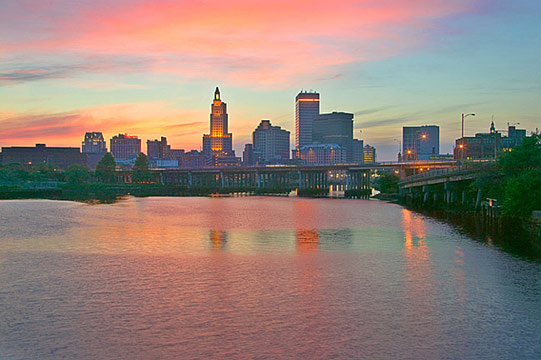
Skylines of the “New South”
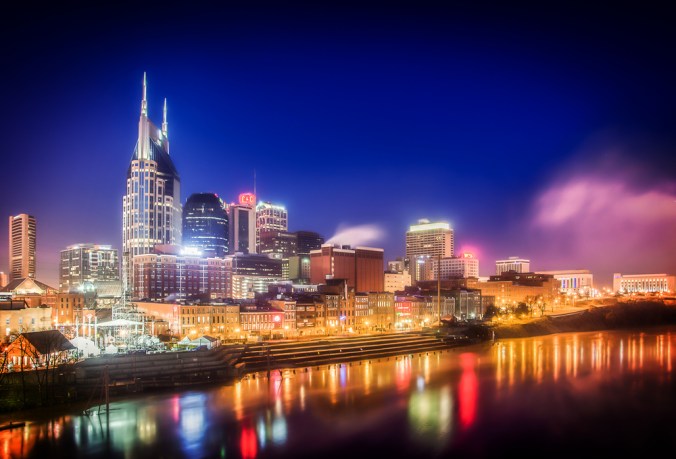
Nashville, Tennessee

Mobile, Alabama

Atlanta, Georgia

Dallas, Texas
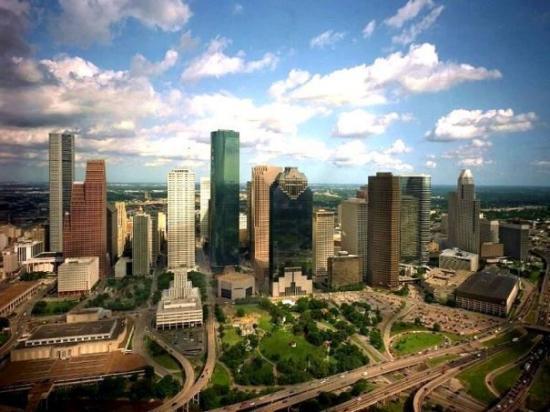
Houston, Texas

Richmond, Virginia

Columbia, South Carolina
This was not the work of one geographic segment of the country, however, it was lifting the entire Nation “into a new life with unparalleled swiftness,” giving labor “a new dignity throughout the whole country.” The expansion of American’s free markets some $35 billion since 1921 alone was not due to mechanical or material causes, they were only possible through the “spiritual regeneration of our country.” It was a laying aside of the “bitterness, hatred, and sectional animosities” which had “retarded” progress for years following the war. Attempting to keep “alive” these “hostile sentiments” for “political advantage” could no longer obtain an accepted place here. Racial and sectional prejudice, part of the human condition everywhere, would never be eradicated completely from every heart but they were alien to the outlooks and principles of reasonable Americans, North and South. A moral renewal had resulted in a material change. This perpetual division and sectional discord would not enjoy a place in the revitalization of America after the War had torn it apart. A new respect for each other must preside here. The floods that had inundated the lower Mississippi Valley that same spring confirmed the North and South were moving together past the old, wasteful and tired attitudes looking, instead, “with pride and satisfaction upon the brilliant contribution which the other is making to the national welfare.” Each part of America “just as eager to help the other as they are to help themselves.” Flood-relief demonstrated this by both levying a sum equal to the cost of the Panama Canal and being largely paid for by Northern states. Coolidge could joyfully commend everyone invested in America’s healing, affirming, “We are a united Nation.”
This was, essentially, why tens of thousands had come to Cannon Falls that day. Our heroes, like Colonel Colvill, inspire us to moral heights, or else they are not authentic heroes at all. The North and South had come back together on firmer foundations because Americans of all sections had risen to the occasion, sacrificing even life itself for the preservation of those “higher things,” the unseen realities, as Coolidge called them. Americans were rededicating themselves “to the support and preservation of those principles which have been revealed to us through the human understanding to be true and demonstrated through long experience to be sound.” Issuing from a renewed faith in those great ideals, all Americans, Coolidge concluded, “have come to increase our admiration for all that is heroic in life, to express our reverence for those who have made sacrifices for the well-being of their fellow men, to renew their fealty to the Constitution of the United States, to rejoice in the universal freedom which it guarantees and in the perfect Union which it has created, and finally for all these blessings in gratitude and humility to acknowledge our dependence upon the Giver of every true and perfect gift.” No firmer basis for summoning the heroism needed to reunite and redeem America can be found than this.

The President at Cannon Falls, dedicating Colvill’s memorial. Courtesy of the Hubbard County Historical Museum.

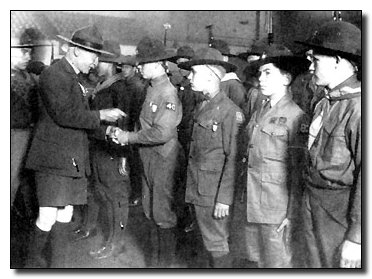

![From "President Coolidge and His Boys," an article written by W. H. Clagett, featured in the October 1923 issue of Boys' Life. Writing to the Boy Scouts of America president, Colin H. Livingstone, on August 16, 1923, President Coolidge not only accepted the honorary leadership of the organization but also commended the work it accomplished, writing, "Both my sons are Scouts, and my observation of the benefits they have derived from their affiliation has strengthened my conviction of [Scouting's] usefulness." Source: http://scoutingmagazine.org/issues/0010/d-wwas.html.](https://salientcal.com/wp-content/uploads/2014/07/ww2.jpg)






 The Importance of the Obvious