On Reasons to Like Coolidge

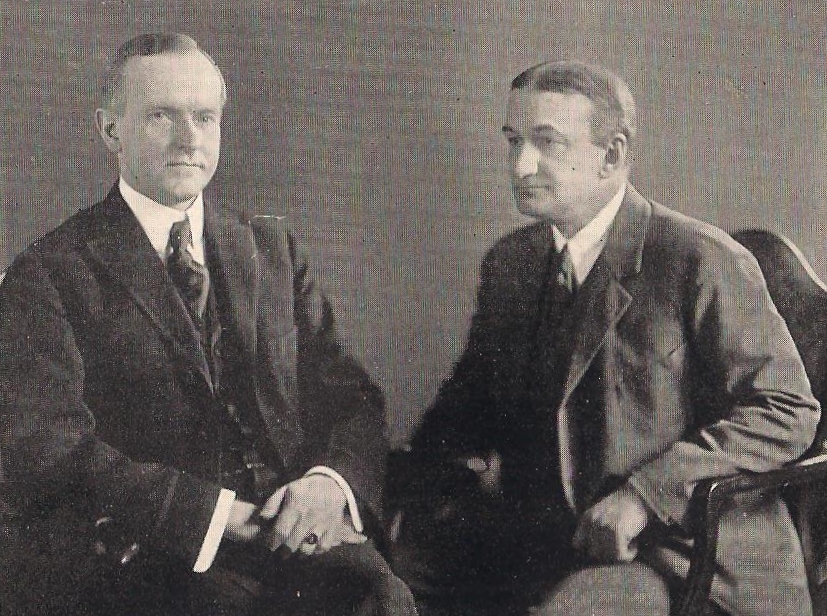
Coolidge and Washburn had served in the state legislature together, each chairing important committees. Washburn was not a distant observer, he knew his subject well.

Coolidge and Washburn had served in the state legislature together, each chairing important committees. Washburn was not a distant observer, he knew his subject well.

One of Calvin Coolidge’s earliest biographers was R. M. Washburn, who includes, in his Calvin Coolidge: His First Biography, this cogent observation from an unnamed but accomplished leader in Washington during the 1920s. A perceptive judge of people, the man once attempted to explain what it was about Coolidge that he found not only admirable but refreshing:

“I like him because I don’t know why I like him; because he don’t seem to care whether I like him or not; because he’s the only one of his species, which I didn’t know existed; because he’s not like other politicians, doesn’t give away cigars, kiss other babies than his own or tell entertaining stories; because he gets by on merit, not personal charm, because to him a political job is a business opportunity; because in easy English, he F. O. B.’s the freight” (p. 113, a shipping term for “free on board,” which in this case is another way of saying Coolidge expected everyone to pull his or her own weight, whether as public servants or private citizens). Coolidge would reliably deliver but he would not abide incompetence or evasion of responsibility. He required others to likewise deliver on their obligations. It may strike some today as a hard stand, but many of our current problems trace back to someone “passing the buck” when it is supposed to stop there, failing either to exercise one’s entrusted responsibilities or hold someone else to theirs. We could use more maturity in our leaders, like that demonstrated by Coolidge. Only then will the heavy lifting, hard work and tough decisions be made by adults ready and able to take up the responsibility of public trust once more.

On Lessons from the Great War

article-2576335-1BD0865300000578-286_964x831

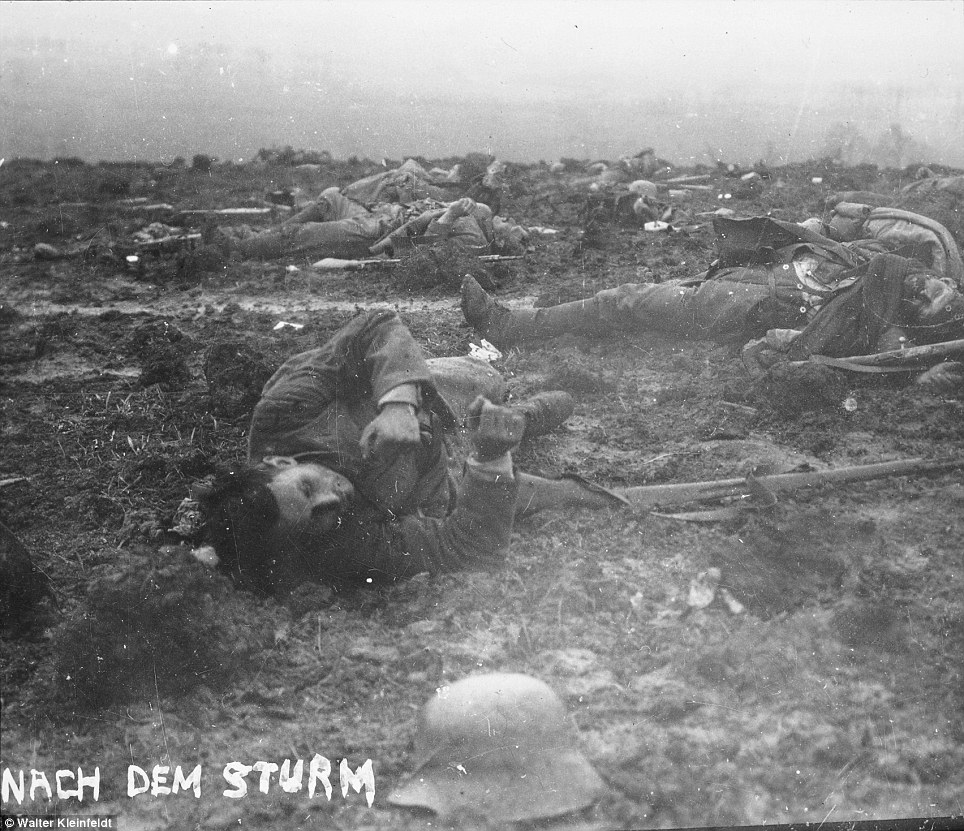
Today, one hundred years ago, the world was engulfed anew in open conflict at the formal declaration of war between Austria-Hungary and Serbia. At its end, some 20 million were dead and another 21 million wounded. Calvin Coolidge had much to say when it came the irretrievable and wasteful loss of war, the terrible destruction it brings upon civilization and yet the justified reasons for our involvement when the rights of our citizens are under attack. It was on one occasion, looking back eleven years after the end of that war, that then-President Coolidge offered these thoughts not only on the horrendous costs but the important lessons from a conflict that both permanently changed his generation and, consequently, the world.

“We thought the question was involved of whether the people of the earth were to rule or whether they were to be ruled. We thought that we were helping to determine whether the principle of despotism or the principle of liberty should be the prevailing standard among the nations. Then, too, our country all came under the influence of a great wave of idealism…No doubt there were other motives, but these appear to me the chief causes which drew America into the World War.

“In a conflict which engaged all the major nations of the earth and lasting for a period exceeding four years, there could be no expectation of materials gains. War in its very essence means destruction. Never before were contending peoples so well equipped with every kind of infernal engine calculated to spread desolation on land and over the face of the deep. Our country is only but now righting itself and beginning a moderate but steady recovery from the great economic loss which it sustained. That tremendous debt must be liquidated through the laborious toil of our people. Modern warfare becomes more and more to mean utter loss, destruction, and desolation of the best that there is of any people, its valiant youth and its accumulated treasure. If our country secured any benefit, if it met with any gain, it must have been in moral and spiritual values. It must be not because it made its fortune but because it found its soul. Others may disagree with me, but in spite of some incidental and trifling difficulties it is my firm opinion that America has come out of the war with a stronger determination to live by the rule of righteousness and pursue the course of truth and justice in both our domestic and foreign relations…

“We had our domestic problems which resulted from the war. The chief of these was the care and relief of the afflicted veterans and their dependents…The Government can do much, but it can never supply the personal relationship that comes from the ministrations of a private charity of that kind. The next most pressing problem was the better ordering of the finances of the Nation. Our Government was costing more than it was worth. It had more people on the pay roll than were necessary, all of which made expenses too much and taxes too high. This inflated condition contributed to the depression which began in 1920…
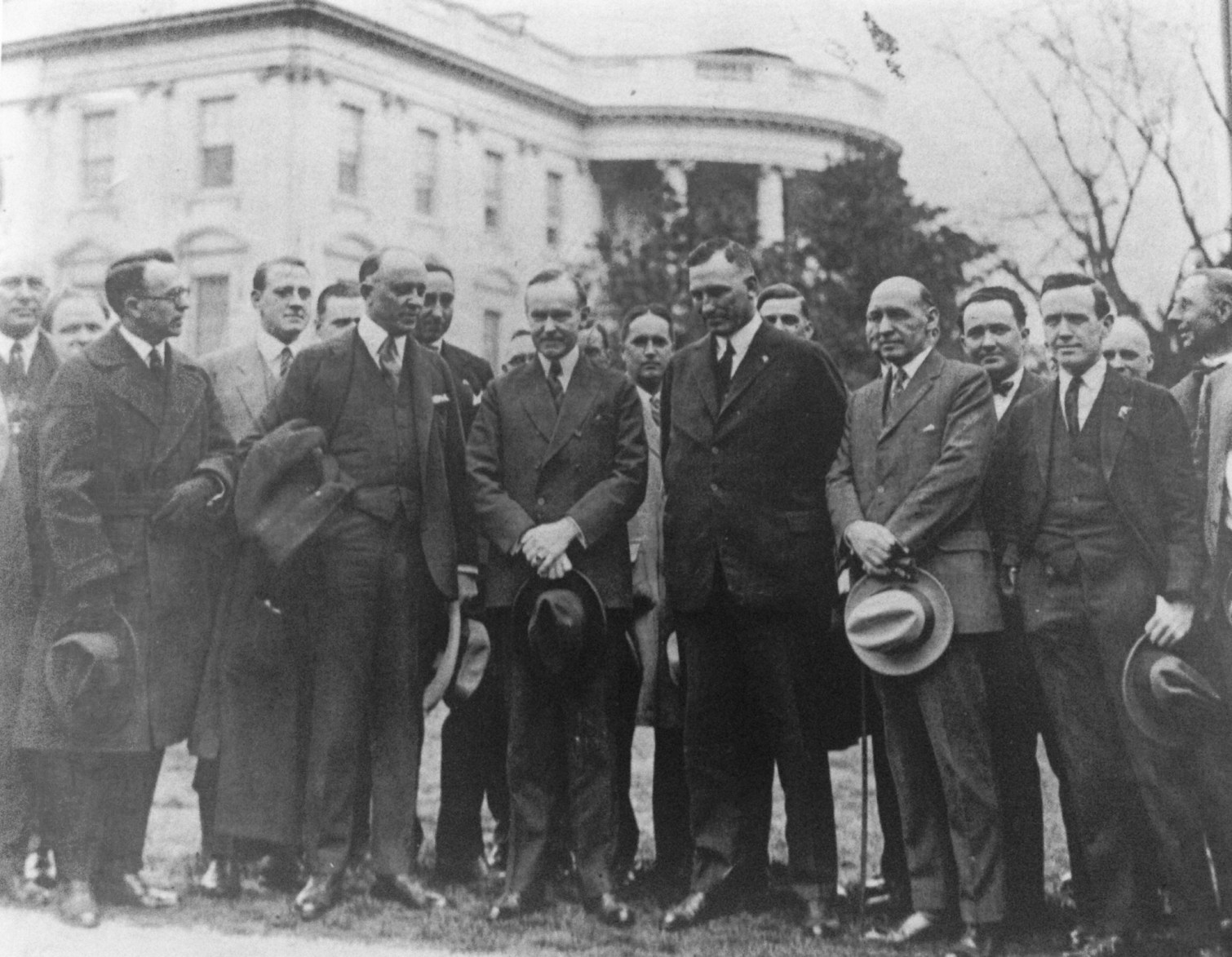
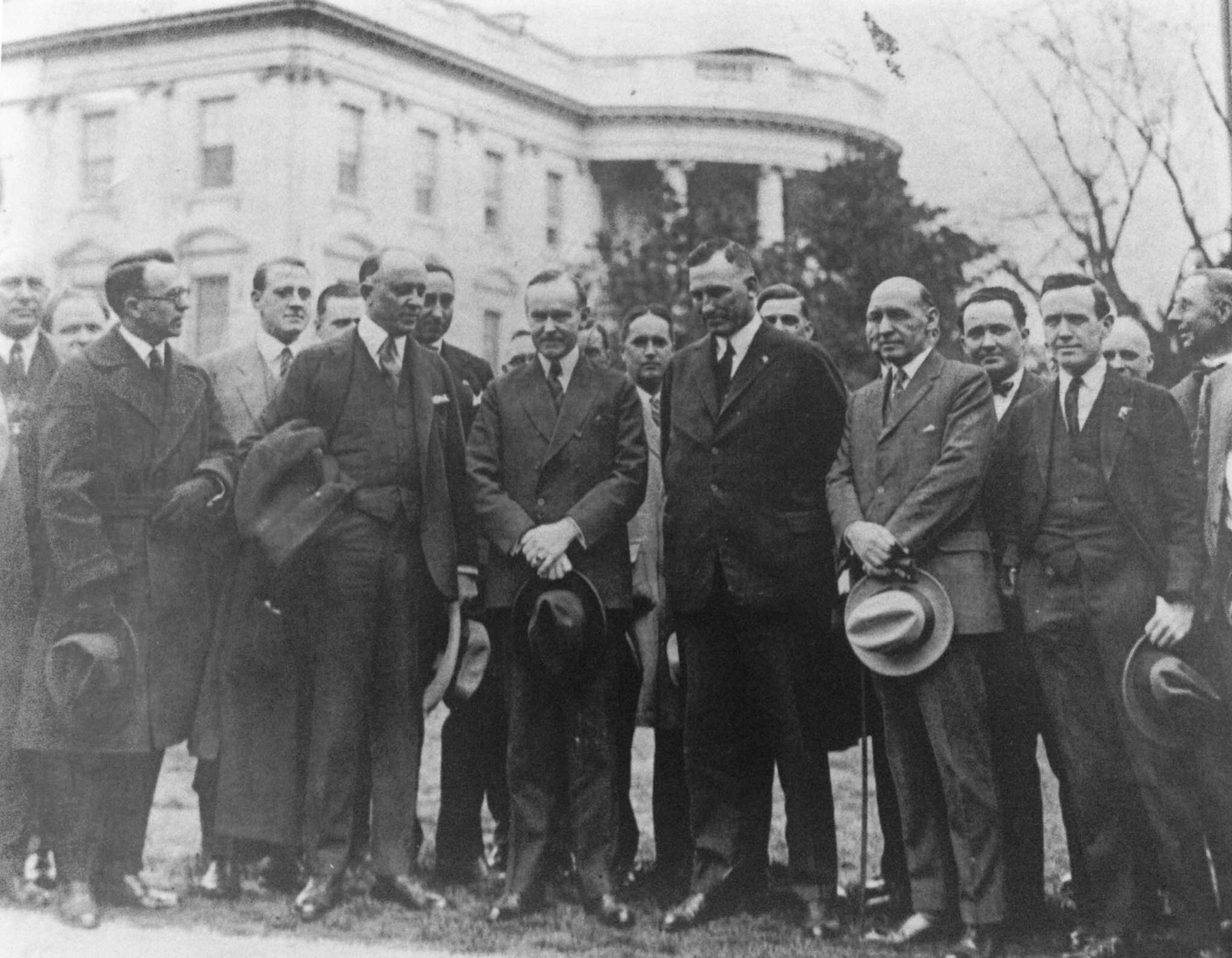
President Coolidge surrounded by members of the American Legion, led by John Quinn, pressuring for the Veterans' Bonus Bill, what would become the World War Adjusted Compensation Act passed by Congress over the President's veto, May 1924. Coolidge firmly disagreed with direct compensation levied upon the rest of the people. As he declared, "patriotism...bought and paid for is not patriotism."

President Coolidge surrounded by members of the American Legion, led by John Quinn (to the right of the President), pressuring for the Veterans’ Bonus Bill, what would become the World War Adjusted Compensation Act passed by Congress over the President’s veto, May 1924. Coolidge firmly disagreed with direct compensation levied upon the rest of the people for the sacrifices, not mere employment, of our military during the war. As he declared, “patriotism…bought and paid for is not patriotism.”

“Our country has a larger Army and a more powerful Navy, costing annually almost twice as much as it ever before had in time of peace. I am a thorough believer in a policy of adequate military preparation…In spite of all the arguments in favor of great military forces, no nation ever had an army large enough to guarantee it against attack in time of peace or to insure its victory in time of war. No nation ever will. Peace and security are more likely to result from fair and honorable dealings, and mutual agreements for a limitation of armaments among nations, than by any attempt at competition in squadrons and battalions…

“The real question is whether spending more money to make a better military force would really make a better country. I would be the last to disparage the military art. It is an honorable and patriotic calling of the highest rank. But I can see no merit in any unnecessary expenditure of money to hire men to build fleets and carry muskets when international relations and agreements permit the turning of such resources into the making of good roads, the building of better homes, the promotion education, and all the other arts of peace which minister to the advancement of human welfare…Whenever the military power starts dictating to the civil authority, by whatsoever means adopted, the liberties of the country are beginning to end. National defense should at all times be supported, but any form of militarism should be resisted.

“Unless the people are willing to defend their country because of their belief in it, because of their affection for it, and because it is representative of their home, their country can not be defended. If we are looking for a more complete reign of justice, a more complete supremacy of law, a more complete social harmony, we must seek it in the paths of peace…

“It is for these reasons that it seems clear that the results of the war will be lost and we shall only be entering a period of preparation for another conflict unless we can demobilize the racial antagonisms, fears, hatreds, and suspicions, and create an attitude of toleration in the public mind of the peoples of the earth. If our country is to have any position of leadership, I trust it may be in that direction, and I believe that the place where it should begin is at home…There have been and will be lapses and discouragements, surface storms and disturbances. The shallows will murmur, but the deep is still. We shall be made aware of the boisterous and turbulent forces of evil about us seeking the things which are temporal. But we shall also be made aware of the still small voice arising from the fireside of every devoted home in the land seeking the things which are eternal.”
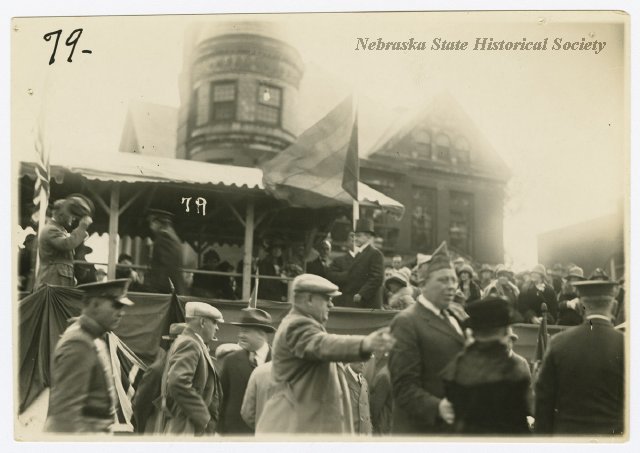
President on a temporary stage at the American Legion Convention, October 6, 1925. Courtesy of the Nebraska State Historical Society.
President on a temporary stage at the American Legion Convention, October 6, 1925. Courtesy of the Nebraska State Historical Society.
Jason Noble Pierce: On the Memory of a Good Boy

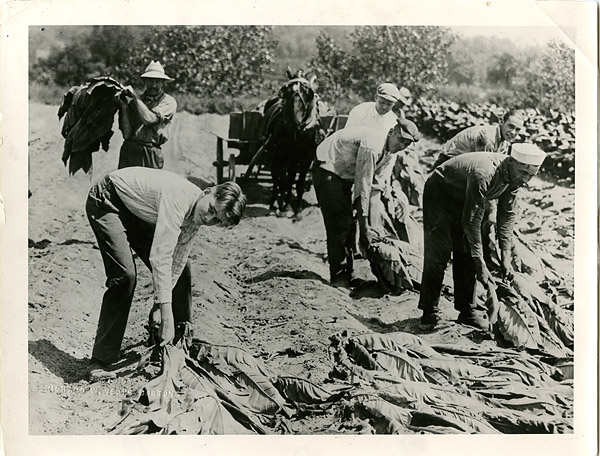
Cal Jr picking tobacco 1923

Cal Jr. at work on local tobacco fields, summer of 1923

Cal Jr. at work on local tobacco fields, summer of 1923. Courtesy of Forbes Library.

As noted earlier this month, July tragically marks the ninetieth anniversary of young Calvin Jr.’s death from sepsis. The life so rapidly taken was immeasurably felt throughout the country. America loved the Coolidges, and the youngest had a particularly special place in the hearts of young and old alike. He had consistently demonstrated a perspective and character that seemed to go beyond his sixteen years.

Attempting to convey the deep impression left upon him by Calvin’s life, Jason Noble Pierce turned the thoughts of those gathered to what Calvin Jr. meant to so many as Pierce addressed the Marble Collegiate Reformed Church in downtown Manhattan the Sunday after the young man’s death. “Every one was disposed to love him,” Pierce would recall. “His youthful life attracted irresistibly. Many people who had never seen Calvin told me that they loved him because of the picture they had seen. Calvin had through all his life the very genuine spirit of religion.” He was not as some boys who go and play “church” because his parents insist or because they live in the public eye. Calvin Jr. sought the One who reveals Himself not merely on tablets of stone but whose writing lives on the heart and in the mind. Young Calvin saw the importance of what is unseen, the preeminence of what is eternal while everything else of this temporal world fades away.

A postcard view of the Marble Collegiate Reformed Church building, Manhattan, where Jason Noble Pierce eulogized young Calvin Coolidge Jr. the first Sunday after his death.

An 1890s postcard view of the Marble Collegiate Reformed Church building, Manhattan, where Jason Noble Pierce eulogized Calvin Coolidge Jr. the first Sunday, July 13, 1924, after the young man’s death.

Granted permission by Mrs. Coolidge to recite an excerpt of the last letter young Calvin had written, Dr. Pierce recounted what the boy had said about one man who had recently discovered a remedy with which to handle his diabetes. Calvin wrote: “He sure was lucky in the time he chose for having diabetes.” Then, the young man reflected, “That last is surely a foolish statement and one that is often made, for we do not believe that life is as happy as death. That’s what Christ told us.”

When Dr. Pierce turned to his efforts that past week to console the grieving President, he said, “I told Mr. Coolidge that in this sickness God was the consulting doctor trying vainly to tell his colleagues here below how to save this life because they were not able perfectly to know God’s laws and that diseases which are fatal today are healed tomorrow.” The discovery of the antibiotic properties of penicillin remained four years in the future while marketable production would not occur until the 1940s. Impossible to know these facts at the time, Mr. Coolidge looked at his preacher and responded, “That may all be true, but what would heaven be like, if it were made up only of old men and old women.” Struck silent by what he had just heard, Dr. Pierce realized that the father possessed the same unshakable measure of faith as his son. It was then, restraining tears himself, that the preacher told the congregation, “That was the time to thank God that in the hour of affliction our great President had no bitterness in his heart and was able to realize he had made a priceless gift, however unwilling must be his sacrifices.”

As the gathering succumbed to tears, Dr. Pierce endeavored to quantify what had given Calvin Jr. so powerful an impact. Finally, the preacher concluded with an encouragement that resonates through these nine decades. Whether we are parents or children, Calvin Jr. inspires us still not merely in the memory of a good young man but with an introspective look at the kind of parents and children or men and women we are, whether faith to us is some useless anachronism or perhaps a rote abstraction in a “church” somewhere or whether faith genuinely lives within us, whether we see the things that are Unseen, as Calvin’s father once put it.

It was, after all has been said, “the religious faith of this lad” that “made him what he was…And as I had the privilege in the intimacy that comes between pastor and parishioners, I saw that the life of young Calvin was a wonderful testimony of obedience.” Remembering all the quiet and unassuming occasions of Calvin’s genuine integrity and example, especially when no one was looking, the preacher concluded, “Here was little lad who never questioned his parents’ direction, but obeyed. That grief-stricken father could only think during those last days of Calvin Jr. as ‘my little boy.’ The doctors said one of the great helps through these days was that it had been Calvin’s life habit to give perfect obedience. Here was a little lad who was winsome and brave, and I imagine that is what Jesus was. Do you know the staff at the White House, who have been through the deaths of some of our Presidents and ex-Presidents, said the mass of small telegrams and telephones that came in after the death of this boy surpassed that received on any other occasion? The lad was a soldier, as brave as brave could be.” Calvin Jr. is rightly remembered for the goodness and strength he exemplified. In his estimation, however, this was no reason to boast of any surpassing excellence in him personally. He was but seeking to place first things first, developing less of material power and more of spiritual power. By first aspiring to walk humbly with God and then serve not be served, both father and son remain testaments to the abiding importance of what is essential and eternal.

Both Calvins, in front of the old home at 21 Massasoit Street, Northampton, 1920

Both Calvins, in front of the old home at 21 Massasoit Street, Northampton, 1920

Calvin gravesites