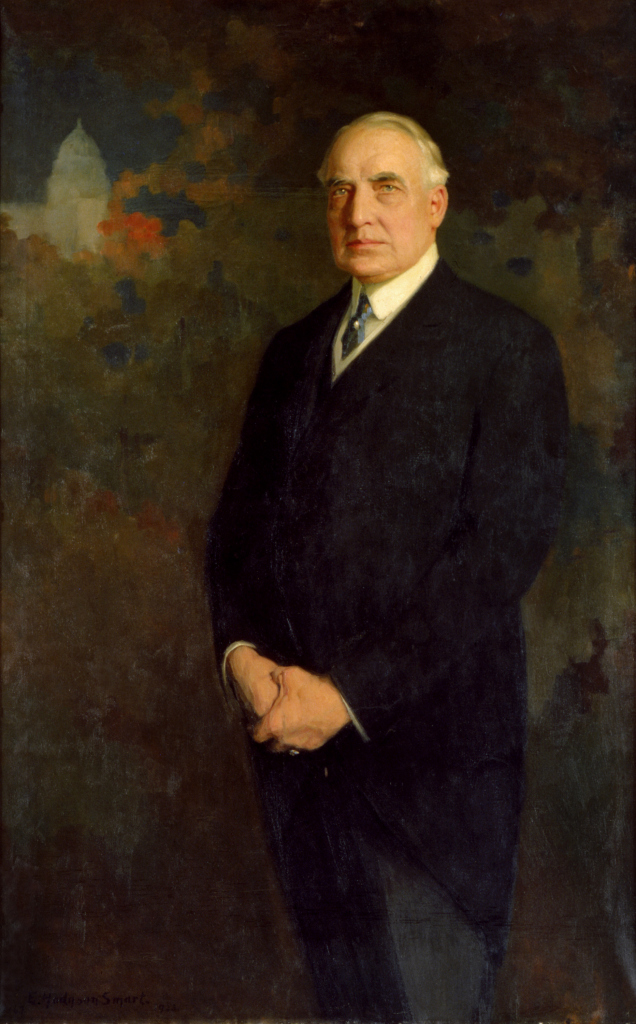
On President Harding

Image

Most historians have been supremely unjust to Warren G. Harding. As Paul Johnson, in Modern Times, observes, the process to create a mythological narrative around the man and his administration started almost immediately. The publication of his papers long ago discredited every mischaracterization which textbooks and authors, who should know better, still repeat as “fact” as they simultaneously omit his accomplishments. It is forgotten that the Harding-Coolidge ticket won an historic landslide on the platform of normalcy, the return of America to the quiet progress of hard work, limited government, civic participation and the true independence of avoiding costly and destructive entanglements abroad, a policy President Washington had warned against less than one hundred and fifty years before.

It is forgotten that Harding achieved much that is worth recognizing today. He guided the nation out of the wreckage of World War, depression and loss laying the foundation for the unprecedented prosperity across the economic spectrum. He showed how to successfully get out of the way in economic hard times by actually cutting 40% of government expenses while reducing taxes, enabling self-correction of the markets to occur and growth to return.

Hoover should have been paying attention.

He is discounted as a poor judge of men but he selected some of the best qualified leaders to serve in the Cabinet, from Hughes at State to Mellon at Treasury.

It was Harding who shepherded the Budget and Accounting Act of 1921 that brought order and responsibility to government budgeting for the first time.

It was Harding who fought for and achieved the first tax cuts of the 1920s, that would pay down the debt, ensure people worked more for themselves than for government, and participated more in their own affairs.

It was Harding, by nominating William H. Taft to be Chief Justice, who merits some credit for the complete reorganization of the Judiciary by the “Judge’s Bill” of 1925, improving much in the way the federal Courts worked so that justice moved swifter and more efficiently.

It was Harding who pardoned Eugene Debs, the Socialist leader imprisoned by the Wilson administration along with numerous others. By doing so, Harding restored a commitment to peace, calm and healing from the discord and division encouraged by his predecessor.

These real accomplishments deserve more consideration than history has given Warren Harding. We deprive ourselves of the constructive lessons he taught when we see only his failures and stop short of understanding his successes. He deserves better. So do we.

Writing of his predecessor, Calvin Coolidge said,

     The country had little interest in mere destructive criticism. It wanted the progress that alone comes from constructive policies…I witnessed the gigantic task of demobilizing a war government and restoring it to a peace-time basis…The efforts of President Harding to restore the country became familiar to me. I saw the steady increase of the wise leadership of Mr. Hughes and Mr. Mellon in the administration of the government and the passing of some of the veteran figures of the Senate…Later it was disclosed that he had discovered that some whom he had trusted had betrayed him and he had been forced to call them to account. It is known that this discovery was a very heavy grief to him, perhaps more than he could bear. I never saw him again. In June he started for Alaska and–eternity.

A reappraisal of his accomplishments is in order. It will reveal a man who defies the conventional wisdom in which he has been relegated and marginalized for more than ninety years. What better time than now to reassess the substance of spending cuts, strict budgeting, individual freedom and a return to our founding ideals, choosing to remain independent and not the vassal of the nations?
On Entering the Presidency

“On the night of August 2, 1923, I was awakened by my father coming up the stairs calling my name. I noticed that his voice trembled. As the only times I had ever observed that before were when death had visited our family, I knew that something of the gravest nature had occurred…He had been the first to address me as President of the United States…He placed in my hands an official report and told me that President Harding had just passed away. My wife and I at once dressed.

     “Before leaving the room I knelt down and, with the same prayer with which I have since approached the altar of the church, asked God to bless the American people and give me the power to serve them.”

The new President’s first thought was to express sympathy to Mrs. Harding and the nation, already beginning to mourn over the late President. Those messages being sent, Coolidge turned to consider the proper form of oath to be taken immediately.

     “Having found this form in the Constitution I had it set up on the typewriter and the oath was administered by my father in his capacity as a notary public, an office he had held for a great many years.”

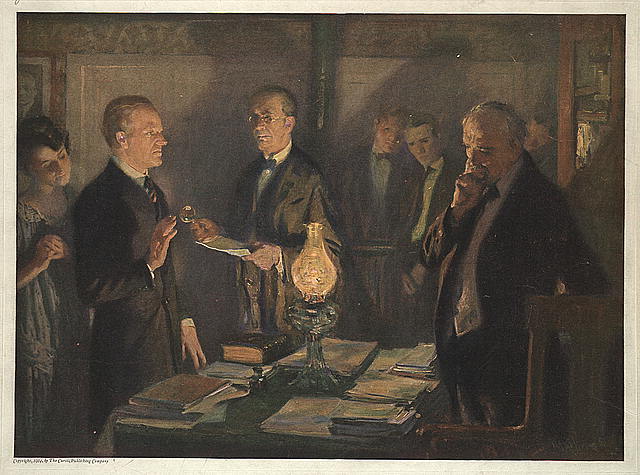
The President, standing in the Homestead sitting room at 2:47 in the morning on August 3rd, described the scene six years later in retirement,

     “The oath was taken…by the light of the kerosene lamp, which was the most modern form of lighting that had then reached the neighborhood. The Bible which had belonged to my mother lay on the table at my hand…Besides my father and myself, there were present my wife, Senator [Porter] Dale, who happened to be stopping a few miles away, my stenographer [Erwin C. Geisser], and my chauffeur [Joseph McInerney].”

In the painting below, is there someone standing in the doorway to the kitchen? How many people do you see?

$(KGrHqV,!rMFHQubHDETBR7C)75ehw~~60_3

     “The picture of this scene has been painted with historical accuracy by an artist named [Arthur I.] Keller, who went to Plymouth for that purpose. Although the likenesses are not good, everything in relation to the painting is correct.”

Scholar and “Coolidge personator,” Jim Cooke, will be reenacting this simple yet solemn ceremony in a few short hours at the Homestead. The gravity and candor of what happened this night ninety years ago remains with us even now. It illustrates the modesty of our system in providing continuity that no other blueprint among human governments has matched. Mr. Cooke’s excellent account of that night, entitled “Dramatis Personae: Plymouth Notch, Vermont” in volume 13 of The Real Calvin Coolidge (1998) presents the best account of this historic transition of power in the most unlikely of places, Plymouth Notch, Vermont. Mr. Cooke presents the enduring mysteries of this night also: from what happened to the typed, signed and notarized oaths to who was actually present in that room. Even now, after all these years, mystery shrouds the occasion. Coolidge, ever an observer of the smallest details, endorses the historical accuracy of Keller’s portrait and gives us all a window into that place and time when Providence raised up the kind of leader President Adams desired ever to occupy the White House.

On Courage and Trust

As America stands poised to face another threat to “shut down” the government (as if that would be harmful), while approaching the initial penalties on individuals by unaffordable health care, a few in the Beltway are realizing what we have known all along: It will not work for anyone now and generations not yet born are to suffer for it. To defund it now, when the Act has already secured the majority of its revenue sources, prompts us to ask, where was the stand to withhold the first dime from this assault on sanity when it originally came to the Congress? Where was the courage among our representatives then? The House has been granted the power to grant appropriations by the Constitution. The House needs to exercise the check on bad laws already in its power. Joining in the implementation of such measures, to any degree, only reinforces the lack of confidence in our system to work as it ought.

The Wall Street Journal on July 21 identified the source of the problem as larger than political bickering or failure to be bipartisan. Too many of both parties have agreed on more than they have disagreed so that principles are rejected for political expediency. Few things are as repulsive to Americans as this manifestation of cowardice in their elected officials. The problem is a pervasive lack of trust. When no one stands up and lives consistent with integrity and moral clarity, it is no wonder no one is inspired to rely on anyone in Washington. It seems no institution, no traditional authority, no individual is untouched by either a severe moral failure or dereliction of responsibilities. The aspiring candidate for mayor of New York City is but a small instance of a vast deficit of confidence in our leaders.

The absence of so essential a component to the health and strength of society is not because government has failed to do enough. Government, of both parties, has already done too much. Moreover, government has repeatedly collaborated to reap this historic lack of credibility in it. Fear, instead of a principled courage, has brought us here now. We do not trust government to find the exit of a brown paper bag and once that trust is lost, the collapse of authority is not far behind unless the people reassert their sovereign will.

Former President Coolidge, observing the calamity of distrust in his day, said,

     Fear is not only contagious, but reaches our representatives. It affects the neighbors and has its reaction on the officeholders. That will be the great difficulty with the Congress and with all the state legislatures. Something is the matter with the country, and they will all feel an irresistible temptation to try to provide a remedy. That would be fine if they had any such power. But only the people themselves have the power to work out of their difficulties, which they can best do without legislative interference.

     The trouble is that efforts will be made to save a situation by legislation when no legislation can save it. In general we may expect to see many proposals to increase expenditures of public money when high national and higher local taxes have been a great contributing factor to the present situation. When the country needs the courage and confidence that relief from high taxes would give, increasing appropriations only add to the discouragement. What a refreshing spectacle it would be if a little band of officeholders would announce they were ready to risk defeat by resisting these unsound proposals! The whole country would rally to their support.

Indeed, we would.

                         Image