On the Dogs

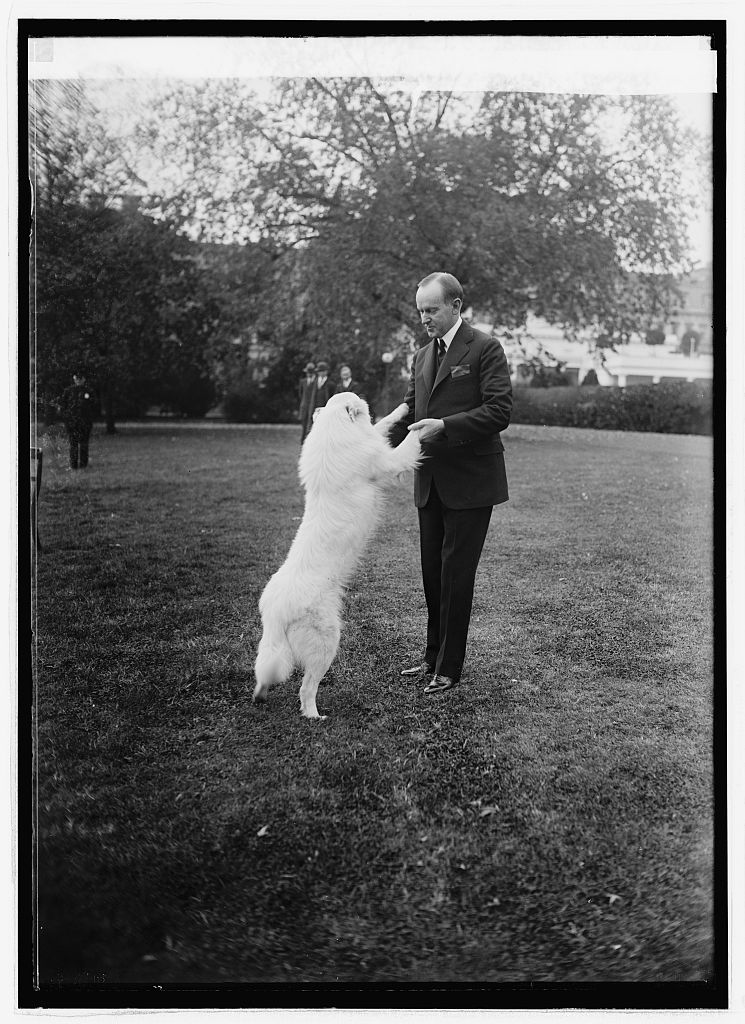
Presidential pets have long enjoyed enthusiastic followings throughout the years. When it came to the Coolidge collies, however, so much affection and fascination came to them that kennel master Harry Waters once remarked, “Sightseers were sometimes more interested in the dogs than they were in the White House.” Ishbel Ross, in her book Grace Coolidge and Her Era, makes it plain, “Rob Roy and Prudence Prim…were king and queen of the kennels” (183). It is Rob Roy who was featured not only in Christy’s famous portrait of Grace but also the official family picture and in the President’s bookplate. The White House staff knew, despite Coolidge’s jokes to the contrary, how much he loved his dogs.

Neither collie had sea legs, however, and when it came to boarding the The Mayflower, not even an executive order could move them. They would sit firmly on their haunches until time to depart would necessitate their return to the White House. While Rob Roy was clearly the king, he still had a princely rival in Paul Pry, the half-brother of Harding’s Airedale, Laddie Boy. When he somehow “escaped” from upstairs and raided one of Mrs. Coolidge’s teas, she speculated how the dog got away. The President explained, without cracking a smile, “I don’t think that little dogs like to be shut upstairs when there is a party going on.” Unruly in temperament, Paul Pry was first conscripted to stay on The Mayflower and eventually found a new home with a Navy family.

Image

The White House was an intimidating place for Rob Roy, at first, after leaving the wide and open spaces of Wisconsin. The elevator was especially daunting for him. Beans, the Coolidge’s female Boston terrier, would bark if Rob Roy tried to leave prematurely, keeping all she considered in her charge safely inside until it was time to leave. Beans went home to Northampton, keeping Grace’s mother, Mrs. Goodhue, company. Rob Roy quickly acclimated and boldly strode the White House grounds, accompanying the President to press conferences, staying at his feet in the Oval Office, and introducing himself to guests at all occasions. On one such occasion, during a breakfast with members of Congress, Senator James Watson recalled that the President let his collies freely roam even after the food was served. Rob Roy came up, received a healthy dose of attention and as soon as the man’s back was turned, “lapped” up all of his sausages and stood, tail wagging, for anything more. It remained almost a running joke that Coolidge often paid far more attention to his dogs than the people in the room. Humor always contains a measure of truth.
            Image

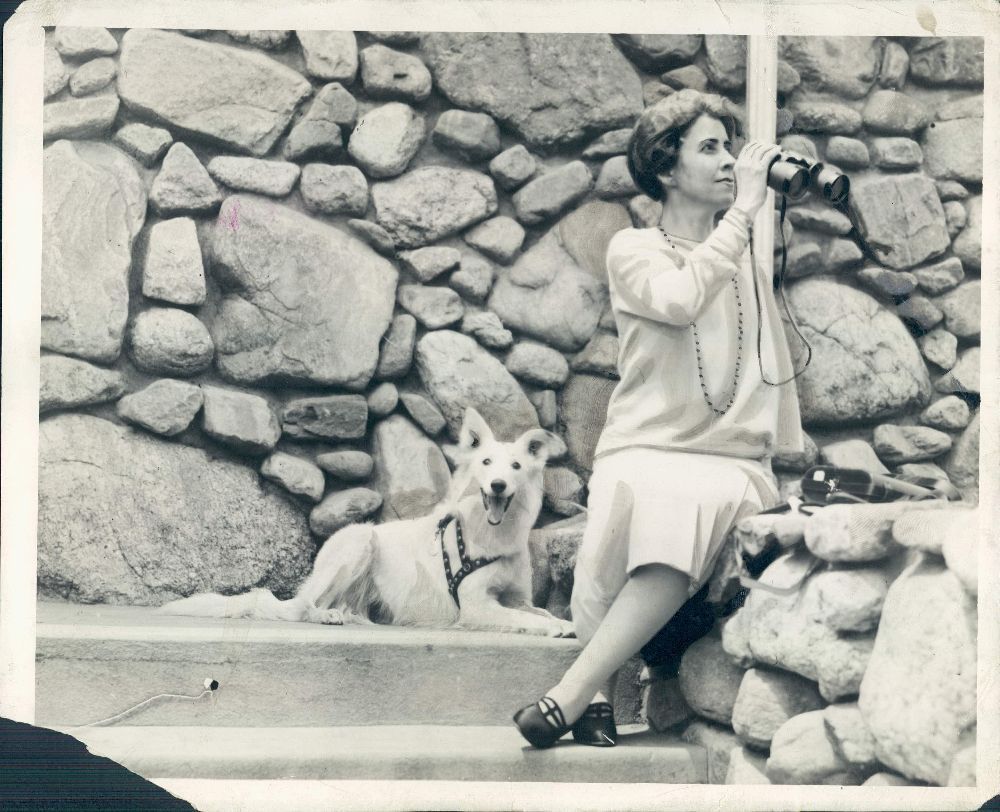
Prudence Prim was Grace’s companion. Mrs. Coolidge loved to leave calling cards claiming to be from the sweet-tempered collie during her visits around Washington. The morning routine for the Coolidges included Prudence bounding in the room, finding her chair and sharing the President’s cereal while most of a roll and bacon strip went to Rob Roy. Both Mr. and Mrs. Coolidge regularly smuggled food off the table for their furry children.

For one of the White House garden parties, Grace dressed Prudence in straw bonnet with ferns and green ribbons; a hat Prudence patiently wore to the delight of everyone. The Coolidges regarded their dogs as persons with whom they conversed and frequently saw human qualities in their behaviors, as many a dog owner can attest. They unwittingly teach lessons of human nature, a fact not lost on the Coolidges. Coolidge would enjoy watching movies with Rob Roy beside him, jabbing the dog in the ribs whenever a funny line came across the screen. He only regretted that the dog could not hear thereby depriving him of the full satisfaction that the President’s conversations were heard.

         Image

Prudence began to wear down in 1927 and she died in South Dakota that summer. “Rob and I shared a common sorrow,” Mrs. Coolidge noted later. Rob, the President’s constant companion, would join her the following year. Dogs would continue to follow wherever the Coolidges went, from Tiny Tim, Diana of Wildwood/Calamity Jane to Beauty and Blackberry. But the favorites were Rob Roy and Prudence Prim.
Image

Grace in South Dakota with Prudence Prim, 1927

In 1929, Coolidge wrote,

We always had more dogs than we could take care of. My favorites were the white collies, which became so much associated with me that they are enshrined in my bookplate, where they will live as long as our country endures. One of them, Prudence Prim, was especially attached to Mrs. Coolidge. We lost her in the Black Hills. She lies out there in the shadow of Bear Butte where the Indians told me the Great Spirit came to commune with his children. One was my companion, Rob Roy. He was a stately gentleman of great courage and fidelity. He loved to bark from the second-story windows and around the South Grounds. Nights he remained in my room and afternoons went with me to the office. His especial delight was to ride with me in the boats when I went fishing. So although I know he would bark for joy as the grim boatman ferried him across the dark waters of the Styx, yet his going left me lonely on the hither shore…”

Image

President Coolidge and Rob Roy at the temporary White House on Dupont Circle in 1927.

On Rejecting the Premise

Calvin Coolidge had the political sense to distinguish between a question designed to bait him and a request for knowledge. Harding could be manipulated; Coolidge could not be coerced. Harding could be distracted from his goals; Coolidge retained focus on his objectives. Those of the “political mind,” as he called it, continually underestimated him as a campaigner, strategist and leader. Based on all they thought they knew about rising to the pinnacle of power, he was not supposed to be there at all let alone win resounding election on his own merits, without being beholden to anyone in the “club” for his success. 

When the Democrats emerged from the circus of their 1924 convention after 103 ballots, John W. Davis was the nominee. In August, he had finally landed on the issue with which to bait Coolidge. He could not use the economy because Coolidge Prosperity, thanks to a tenacious combination of budget cutting and further tax reduction, was underway. He could not use law and order because Coolidge had already preempted the issue on every front from lynching to labor to immigration to cleaning up the messes left by Harding’s unscrupulous “friends” in the Justice and Interior Departments as well as the Veteran’s Bureau.

Davis finally could force Coolidge into a very tough position with voters — call out the Klan, Davis challenged in August that year — a move that would surely alienate one side or the other. Instead, Coolidge said nothing. On the contrary, he had already made clear his resolve against the Klan. To address it would simply legitimize its influence. Coolidge was not going to validate its destructive mission. Instead, he had already begun traveling around the country to speak and participate in the projects of every group the Klan targeted: Jews, Catholics and immigrants, sending the proper message that each audience was engaged in the building up of our ideals while hatred, division and segregation contribute nothing to America’s progress.

The previous October at the White House he met with and expressed support for the American Jewish Congress.

In January of 1924 he commissions W. E. B. DuBois, known for his work in education and toward full assimilation, to represent the United States at the inauguration of Liberia’s new president.

In March Coolidge had taken up the unsuccessful effort under Harding to appoint Walter L. Cohen, an accomplished Louisiana businessman, to serve as collector of customs for New Orleans. After securing him as a recess appointment, Coolidge finally saw the Senate confirm the man despite the opposition of Cohen’s own governor, and federal Senators.

On June 6, Coolidge comes and speaks to Howard University before the students and faculty of that flourishing institution. Their motto, Veritas et Utilitas (‘Truth and Service’), no doubt held great meaning for Coolidge.

On August 9, Coolidge, in response to a letter from Charles F. Gardner who was protesting the candidacy of a black man in his area, writes a resounding rebuke published in The Literary Digest that same month.

On August 23, Coolidge’s Vice-Presidential nominee, Charles G. Dawes, goes straight at the Klan with a public condemnation during a speech in what was a Klan-stronghold, Augusta, Maine.

Two days later, August 25, Coolidge and Dawes meet in Plymouth where the President commends the speech as “good.” A hearty endorsement with someone of his reticence. 

On September 2, expert attorney, William Clarence Matthew, who happens to be a black man, is named to help the Coolidge campaign.

On September 21, Coolidge addresses thousands of Catholics gathered to hear him talk about “Authority and Religious Liberty” to the Holy Name Society in Washington.

On September 26, Coolidge meets with “Mother Jones,” the controversial co-founder of the Industrial Workers of the World, an organization largely comprised of new immigrants.

On October 15, Coolidge takes up the universal impact of “Religion and the Republic,” reminding the nation of each individual’s moral obligations to others.

On October 16, Coolidge stands before a group of recently naturalized citizens and praises “The Genius of America,” a melting pot built on common ideals of freedom, law and equality before God.

The following day, October 17, Coolidge welcomes a delegation of actors and performers including the Lithuanian-born Jew, Al Jolson, already known for his belief in full assimilation for minorities.

Finally, on October 26, Coolidge speaks on “Discriminating Benevolence” to the Federation of Jewish Philanthropic Societies of New York City.

While this is but a partial chronology of all Coolidge was doing, obviously not including all he did with those the Klan despised throughout his years in office, it illustrates how the Klan’s retreat during the Coolidge years was hardly coincidental. It all happened without passing a law, issuing an executive order or reacting to others’ expectations of what he should do. Actions always meant more than words to Coolidge. It was not enough to say you cared, you best show it. Rejecting the premise set for him, Coolidge pointed back with his behavior to something more essential than our base desires…the love we owe our neighbor.

Coolidge took action and those quiet rebukes accumulated until no respectable place was left to nurse animus toward skin color, religious belief, or ethnic background. He succeeded in revealing the Klan for what they were: small, petty, and unreasonable. He staked out the ground for respect and understanding when it was most unpopular to do so and thereby, without saying so, helped the country reconnect with its ideals.

Image

President Coolidge speaking at the dedication of the Jewish Community Center in Washington, D.C., May 1925.

On the Death of President Harding

“Reports have reached me, which I fear are correct, that President Harding has gone. The world has lost a great and good man. I mourn his loss. He was my chief and my friend.

     “It will be my privilege to carry out the policies which he has begun for the service of the American people and for me to meet their responsibilities whenever they may arise.

     “For this purpose I shall seek the cooperation of all those who have been associated with the President during his term of office. Those who have given their efforts to assist him, I wish to remain in office, that they may assist me. I have faith that God will direct the destinies of our nation.

     “It is my intention to remain here until I can obtain the correct form for the oath of office, which will be administered to me by my father, who is a notary public, if that will meet the necessary requirement. I expect to leave for Washington during the day.

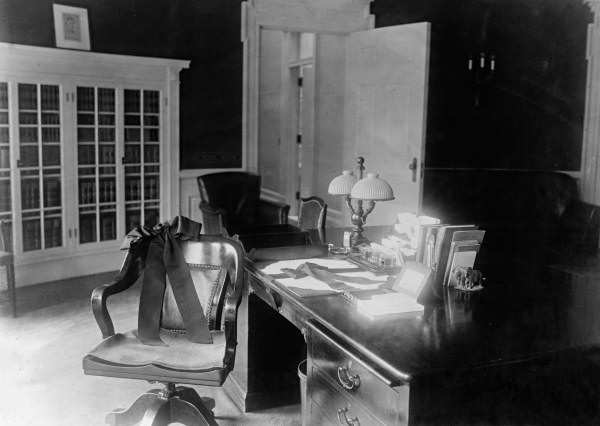
These words, delivered on the announcement that the President had died thereby leaving Calvin Coolidge to succeed him on August 3, 1923, underscore the profound importance of our institutions as constituted. Coolidge’s oath by his own father, a local notary, could not have made the point any clearer. This is our nation and our government. We make it work for us.

America is unique for so simple and orderly a process of succession but it is also profoundly grieved when it loses good leaders. The path blazed by Harding would continue under Coolidge. That simple expression of continuity, respecting our will at the ballot box, comforted a nation that genuinely and rightly missed a President who had lit the way back toward our American ideals of self-reliance, understanding and independence.

Image

This is a scene from the Oval Office with the President’s chair in mourning ribbons in observance of President Harding’s death, 1923.