At the NATO Summit in Strasbourg, France, back in 2009, the current assessment of what makes America exceptional was summarized this way, “I believe in American exceptionalism, just as I suspect that the Brits believe in British exceptionalism and the Greeks believe in Greek exceptionalism.” This familiar statement from four years not only misses the point, perhaps even intentionally, but also repudiates the profound distinction.
Outsiders mistake it for arrogance, as if humanity itself does not struggle with hubris, envy or selfish ambition. In purely material terms, America has made possible an unprecedented standard of living, a presence felt globally, and a recurring willingness to aid those in need anywhere in the world. In moral and spiritual terms, the Founders, by studying the ideas of those who came before them, discovered that a system of self-government, protecting the individual by strictly limiting the powers of the State, rather than the reverse, was the basis for a free and fair society. Up to then, the norm had been to empower rulers over individuals, to secure the State. The people revolved around government. Now the balance was returned to recognizing the individual as sovereign while restraining government power. This discovery wrought exceptional results, even with all the obstructions, setbacks and difficulties Americans have encountered in a short two hundred and forty years.
It is in this way, by restoring the ideals of self-government to the foundation of society, that America found they were the exception to the way the rest of the world chose to work. This is American exceptionalism: adopting a set of ideals that all who come here must share if liberty is to remain for everyone. Those ideals must also be infused with hard work to find opportunity and exercise the responsibilities of independence. Those unfamiliar with our optimistic ideals, accept defeat when faced with the slightest resistance of circumstances. Millions around the world languish in real need and emptiness because of this lack of faith in people to govern themselves. Sovereignty resides in the few at the top with privileges doled out and taken back when it suits. Humanity shares this test everywhere. We are no different. It is in America, though, that a deliberate choice has been made to depart from this oppressive and wasteful system of controls, embracing instead the higher ideal of independence with responsibility.
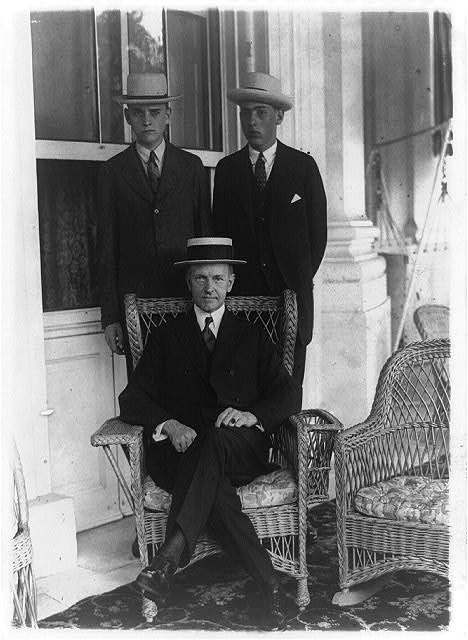
Calvin Coolidge saw this impasse and explained it in 1923 this way,
“There are two broad theories which have held sway in the world. They have developed with the development of the [human] race. One is the system of class and caste, of a claim of divine right of rulers by inheritance — a system where the individual is nothing and the government is all supreme…
“There is another system with which every American should be familiar, a system of equality and of freedom, not without the claim of divine right, but recognizing that such right reposes in the people; a system where the individual is clothed with inalienable rights, the people are supreme, the government is their agent. Under this conception there is real freedom, real independence, and grave personal responsibility. The rulers look to the people. Their authority is the public will, ascertained in accordance with law. There will be the least possible interference with private affairs. Realizing that it is people who support the government and not the government which supports the people, there will be no resort to paternalism. Under such institutions there may appear to be a lack of machine-like efficiency, but there will be no lack of character. Private initiative will be stimulated. Self-reliance and self-control will be increased. Society will remain a living organism sustaining hope and progress, content to extend its dominion not by conquest but by service. Such is the system of self-government, the orderly rule of the people, carrying within itself a remedy for its own disorders and the power of self-perpetuation. This is the ideal of America.
“No one would say that existence under these conditions is effortless. Independence is exceedingly exacting, self-control is arduous, self-government is difficult. Always there is the temptation that some element of these should be surrendered in exchange for security and ease [emphasis added]. The appeal to passion and prejudice always lies in this direction. The proposal to despoil others of their possessions is a manifestation of the same spirit. This is reason that to certain of our native-born, and more often to our foreign-born, the American Republic proves a disappointment. They thought that self-government meant the absence of all restraint, that independence meant living without work, and that freedom was the privilege of doing what they wanted to do. It has been a hard lesson for them to learn that self-government is still government, that the rule of the people does not mean absence of authority, that independence means self-support, and that, complete freedom means complete obedience to law. They are disappointed more than ever when they learn, as ever they do, that these are so, not because they have been decreed by some body of men, but that they are so by the very nature of things, and all the governments in the world are powerless to change them.
“Here again it is perfectly obvious that if the American system is to be cast aside there is only the one other system which can be adopted. The call of the old life of ignorance, of fear, of superstition, of every savage instinct is all toward the old system. The call of the new life of learning, of courage, of enlightened reason, of faith, of religion, is all toward the new system” (quoted from “Calvin Coolidge: His Ideals of Citizenship As Revealed Through His Speeches and Writings” by Edward E. Whiting, Boston: W. A. Wilde, 1924, pp.20-23).



 The Importance of the Obvious