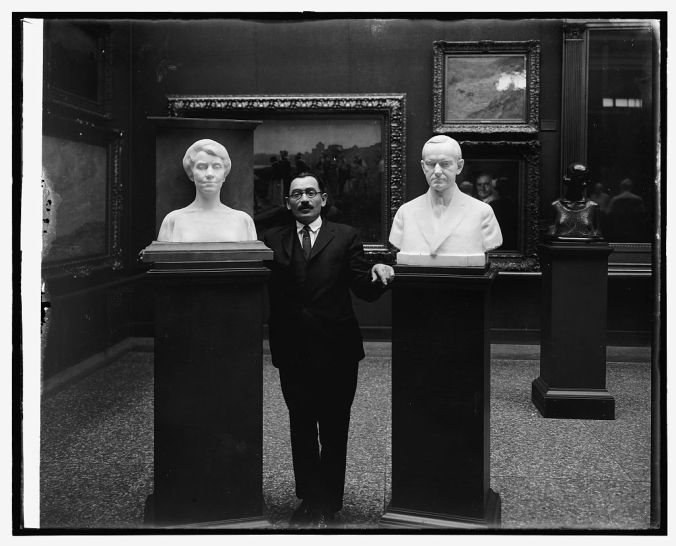
“Now we will have some real fun”

These busts, sculpted by the Lithuanian Moses Dykaar, who is here displaying his work, began from both the President and First Lady sitting for him over the course of a few months, late in 1923. They were unveiled in January 1924. The artist was known for expecting his subjects to be expressive and lively during such sittings. Coolidge, predictably, was not so obliging. But as Dykaar prepared to carve the finishing touches on Coolidge’s bust, he began to hear the President recount a series of jokes, even engaging in “pleasantries” with the sculptor Suddenly, the President said, “Now we will have some real fun,” at which Dykaar looked up just in time to see the President practicing various grimaces and wiggling his ears! How is that for expressiveness?!

This story, recounted in The New Yorker (September 8, 1928 issue) was repeated in May 1931 by David Schwartz in the National Jewish Ledger. It is interesting that Dykaar was not actually commissioned to complete the sculpting in marble until 1926. He would complete the work the following year and it was not until 1929 that the only bust to feature a living person was quietly installed in the Capitol. Ironically, one of the bust’s ears was damaged and promptly repaired twice, once when first installed and again in 1943. Dykaar would produce copies for both Amherst College and Forbes Library.

On Scandals

As the details became known of what had transpired when government officials used patronage on friends in favored businesses, President Coolidge would set the tone, in February 1924. Coolidge would explain how he and those under his authority would act to restore integrity, punish the guilty and represent all, not merely a preferred few, Americans,

“Character is the only secure foundation of the state. We know well that all plans for improving the machinery of government and all measures for social betterment miserably fail, and the hopes of progress wither, when corruption touches administration. At the revelation of greed making its subtle approaches to public officers, of the prostitution of high place to private profit, we are filled with scorn and indignation. We have a deep sense of humiliation at such gross betrayal of trust, and we lament the undermining of public confidence in official integrity. But we cannot rest with righteous wrath; still less can we permit ourselves to give way to cynicism. The heart of the American people is sound…For us, we propose to follow the clear, open path of justice. There will be immediate, adequate, unshrinking prosecution, criminal and civil, to punish the guilty and to protect every national interest. In this effort there will be no politics, no partisanship. It will be speedy, it will be just. I am a Republican but I cannot on that account shield any one because he is a Republican. I am a Republican, but I cannot on that account prosecute any one because he is a Democrat…Distressing as this situation has been, it has its reassuring side. The high moral standards of the people were revealed by their instant reaction against wrongdoing.”

The same high standards are maintained when we, the sovereign people, hold our officials to account for mismanagement and dereliction of their sworn duties. Coolidge did more than outline what needed to be done, he did it by appointing a special counsel team to investigate and prosecute both civil and criminal wrongs, by issuing executive orders commanding entire departments be turned upside down to provide all the information investigators requested, by firing his Attorney General for refusing to comply, and welcoming the start of litigation well before the elections of 1924, even when it could have destroyed his chances for election. His clarity in both word and deed demonstrated the right way to handle government abuse of authority, even when it concerned inherited circumstances. Contrary to Hillary Clinton, it still makes a difference at this point.

Image

“Why I Am A Republican”

“Why I Am A Republican”

The recent statement of Mr. Elbert Guillory explaining his change of support for the historical principles of the Republican Party echoes many of the thoughts expressed by our thirtieth President, Calvin Coolidge. He would have stood with this man, an American who understands the duties of freedom, to advance our common cause of citizenship. As Coolidge would say back in 1922, “The meaning of America is not to be found in a life without toil. Freedom is not only bought with a great price; it is maintained by unremitting effort. The successful conduct of our economic life is not easy. It cannot be made easy. The burdens of existence, the weight of civilization, cannot be taken from the people.” The government that promises to lift such burdens cannot and never will. It will only result in further loss to people’s liberty in the name of protection.

Coolidge would assess difficulties not unlike what we now face, “The final solution of these problems will not be found in the interposition of government in all the affairs of the people, but rather in following the wisdom of [George] Washington, who refused to exercise authority over the people, that the people might exercise authority over themselves.” Addressing men and women at Howard University he spoke with the fullest confidence in individuals just like Mr. Guillory to embrace the opportunities of self-government and to realize the potential freedom holds from all forms of enslavement, mental as well as physical. He would champion the example of folks like Mr. Guillory without pretense or condescension, when he said, “The Nation has need of all that can be contributed to it through the best efforts of all its citizens…We can not go out from this place and occasion without refreshment of faith and renewal of confidence that in every exigency our Negro fellow citizens will render the best and fullest measure of service whereof they are capable.”

That service, seen in the examples of Senator Guillory, Dr. King, Dr. Robert Moton, Justice Thomas and Dr. Carson (to name but a few), is not to preserve the “masters” of the Democrat Party establishment, to prop up dependance on Washington (or bondage to any administration for that matter) but is living up to the highest ideals of American citizenship. It is an expression of the spirit of self-reliance, a fulfillment of duty to God and family, and a giving of one’s self in civic participation, that makes our freedom possible.